AI agents found a Maya site that was already on the map
Pietro Miotti used 48 AI agents on NASA lidar data to reach a Maya site; a day after posting, he wrote that it had already been mapped in a 2025 paper.
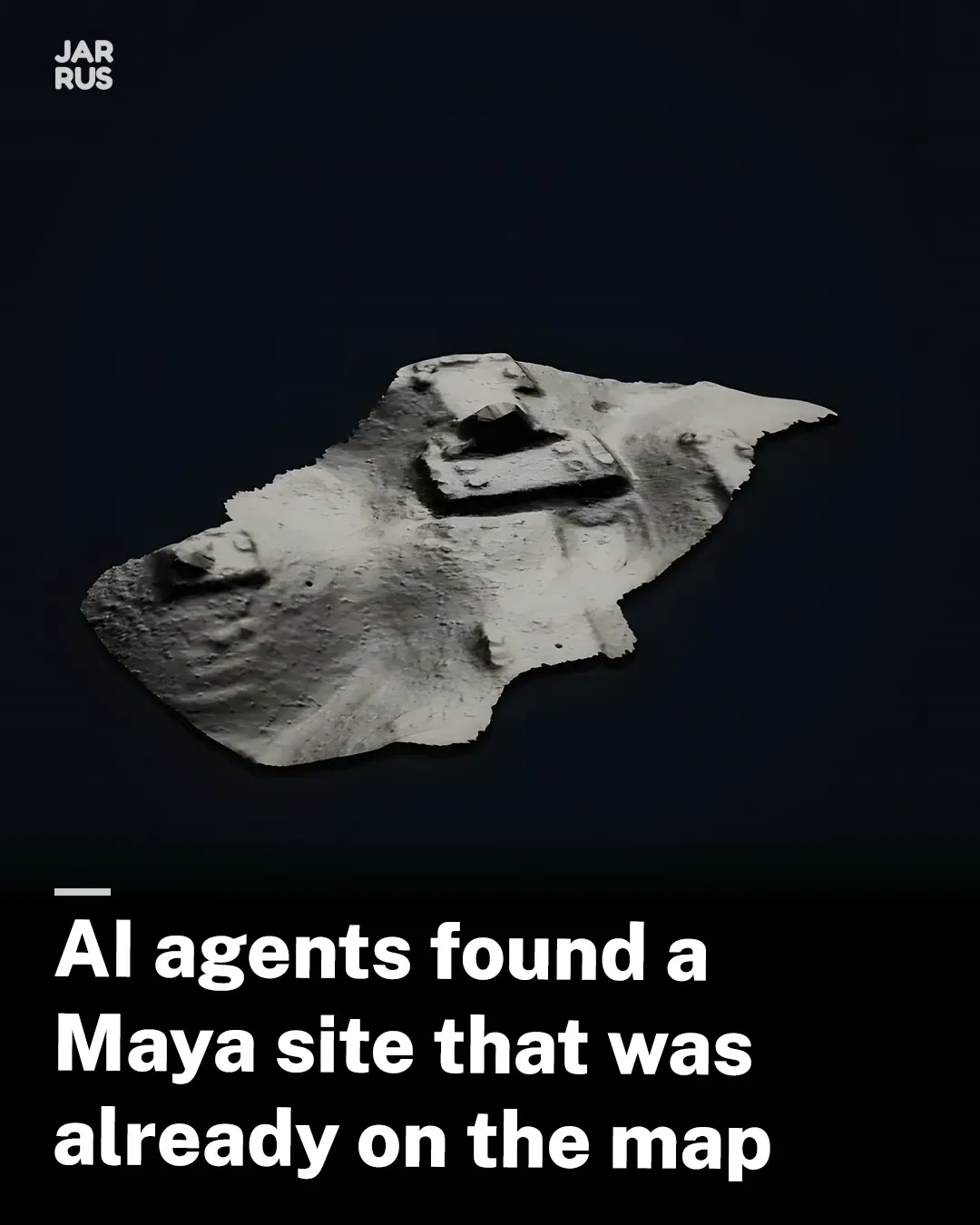
Cover of the Instagram post.
Sources: Pietro Miotti, X, INAH / Secretaría de Cultura +4
A question on vacation
Traveling in Peru in mid-October, AI researcher Pietro Miotti was reading about Hiram Bingham, who reached Machu Picchu in 1911, and asked a question: what would Bingham do with today’s tools?
Gemini, ChatGPT, Claude and Grok all gave the same answer: lidar. Miotti, who is not an archaeologist, turned to the Maya region, where more public lidar data exists.
48 agents, 1,200 km² of forest
Miotti turned lidar from about 1,200 km² of forest, scanned by NASA’s G-LiHT project in 2013, into images and had 48 agents go through them one by one. There was no custom model; the agents looked for pyramids, platforms and plazas using a detailed guide.
Then he asked which of these didn’t appear in the literature or archives. One site was left.
A plaza under the trees
Lidar reveals the ground beneath the trees. As Miotti reads it, the site has a plaza, an oval pyramid at least 8-12 meters tall, a raised courtyard and three platforms around it.
Miotti himself calls this interpretation speculation, and he has not shared the location to guard against looting.
A Spanish report, a reply the next day
The agents suggested reporting the site to Mexico’s National Institute of Anthropology and History (INAH). Miotti, who doesn’t speak Spanish, sent the agents’ Spanish-language report on Oct. 20.
INAH replied the next day: no registered archaeological site at the location. That was not a confirmation of a discovery.
1.38 million views
On Nov. 10, Miotti shared the story on X: “My AI agents found an unmapped Maya site in Mexico.”
The post drew 1.38 million views and more than 20,000 likes.
 Pietro Miotti@PietroMiotti
My AI agents found an unmapped Maya site in Mexico, using LiDAR data from a NASA dataset.
72 hours from a random thought on vacation to a reply from Mexico's national archaeology institute.
What a time to be alive…

The correction the next day
On Nov. 11, Miotti posted an update: the site had already been mapped in a paper published in 2025. The agents missed it while going through the literature, and so did he; it just wasn’t in INAH’s register yet.
The correction drew a little over 5,000 views, against 1.38 million for the first post.
Pietro Miotti@PietroMiottiUpdate: the site had already been discovered. It appears in a 2025 paper by Estrada-Belli, Canuto, Šprajc & Fernandez-Diaz (page 14) doi.org/10.1016/j.jasr…
What archaeologists say
Ivan Šprajc, who spoke to The Verge and co-wrote the 2025 paper, said just spotting something does not add much to our knowledge and that consulting INAH is not sufficient. UCL’s Elizabeth Graham said the real problem is not discovering new sites but funding to excavate and map them.
Sources
8 sources
- “My AI Agents (Re)discovered a Maya Site in 72 Hours”Miotti’s diary of 18-21 October, method, INAH reply and the 11 November correction. · pietromiotti.com
- “Respuesta a aviso de posible sitio arqueológico (Oficio No. 401.3S.4-2026/1476)”INAH reply letter (image shared by Miotti); no registered site. · x.com
- “No, AI agents did not discover a previously unknown Maya site”Robert Hart; criticism from Šprajc, Graham and Parcak, and Miotti’s response. · theverge.com
- “New regional-scale Classic Maya population density estimates and settlement distribution models through airborne lidar scanning”Estrada-Belli, Canuto, Šprajc, Fernandez-Diaz; the paper where the site appears (vol. 66, 105288). · doi.org
- “NASA Goddard’s LiDAR, Hyperspectral and Thermal (G-LiHT) Airborne Imager”Paper describing the NASA G-LiHT lidar system used. · doi.org
- “Running out of empty space: environmental lidar and the crowded ancient landscape of Campeche, Mexico”2024 study mapping Maya settlements in Campeche with the same kind of lidar data. · doi.org
About this story
- Written by
- Yiğit Kasap · JARRUS
- Story date
- On the site
- since Nov. 20, 2026
- Short link
thejarrus.com/en/ai-agents-maya-site- Report an error
- Spotted an error in this story? [email protected] · Instagram
On the same topic
Turkish mathematician Levent Alpöge says he proved the Riemann Hypothesis with Claude
Meta’s AI agent Muse mixed up different people’s conversations and surfaced private data in internal testing, report says
Apple is hiring a senior engineering manager for its own Mac-controlling AI agent, Bloomberg reports