Turkish mathematician Levent Alpöge says he proved the Riemann Hypothesis with Claude
The 17-million-line Lean proof passed checks and the Lean community calls it correct; there is no readable proof, and understanding it will take time.
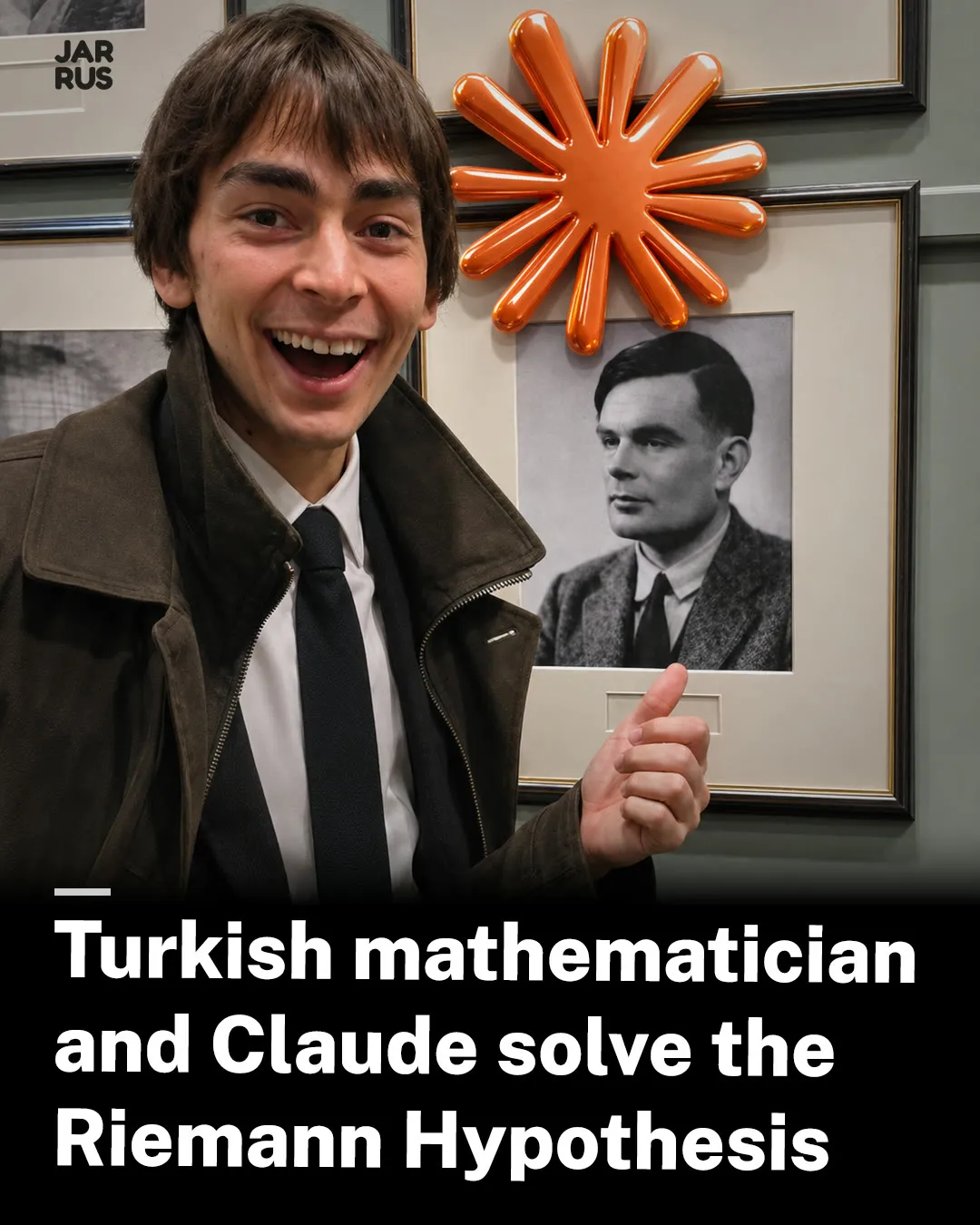
Cover of the Instagram post.
Sources: Levent Alpöge, Lean and Mathlib communities, Andrew Sutherland +6
A four-page note
Levent Alpöge, a mathematician at Anthropic, posted a four-page note on his personal site on Nov. 20. It says: “I believe I have, working with Claude, discovered a proof of the Riemann Hypothesis”.
He writes that the method also resolves the Generalized Riemann Hypothesis. About Claude, he says: “this time Claude far outpaced me near the finish line.”
A 167-year-old question
In 1859, Bernhard Riemann linked the distribution of prime numbers to the zeros of the zeta function. He proposed that all the interesting zeros lie on a single line with real part 1/2.
The first 10 trillion zeros have been checked, but there was no proof. It’s one of the Clay Institute’s seven Millennium Problems, each worth $1 million.
15 million views
The note spread fast on X. Yifan Zhang’s post sharing it as “Riemann Hypothesis has been solved” passed 15 million views. Harry Stoltz’s post, among the first to spread it on X, came at 13:49 UTC on Nov. 20, and Scientific American’s story at 14:00 UTC.
But the post only repeats the claim. Alpöge himself doesn’t say he solved it; he says he believes he discovered a proof.
Who is Levent Alpöge?
Born in 1992 in New York, Alpöge is a U.S. and Turkish citizen according to his CV, and lists Turkish as a native language. He studied at Harvard and did his PhD at Princeton under Manjul Bhargava.
A Harvard Society of Fellows member, he now works at Anthropic. In 2023 he taught at the Nesin Mathematics Village in Şirince, Turkey.
Not a book: 17 million lines of code
Alpöge released only code written in Lean, a proof-checking language: about 17 million lines in 175,187 files. On Nov. 21, the Lean and Mathlib communities said both the statement and the proof are correct.
MIT’s Andrew Sutherland ran checks that passed too; a few were still running on Nov. 22. According to Sutherland’s dashboard, all 175,187 modules compile without errors, the five headline theorems depend only on three standard axioms (propext, Classical.choice, Quot.sound), and independent kernels accept the proof; as of 04:35 UTC on Nov. 22, the lake comparator run and the Lean-kernel replay were still in progress. The Generalized Riemann Hypothesis verified in Lean covers only Dirichlet L-functions.
The “250,000-page proof” claim circulating on social media is wrong: per Alpöge’s footnote, that is the length of the unpublished human-language text Claude produced. “Solved in 41 days” is also a derived figure; the timeline in his note runs from Oct. 6 to Nov. 16, but Alpöge writes that he has worked with Claude for months.
Lean says yes, humans not yet
Lean checks that every step is valid, but it doesn’t explain why the proof works; there’s no human-readable proof. Terence Tao wrote that digesting it will take time, and Andrew Granville called what was released “garbled.”
The Clay prize needs publication, two years and general acceptance. Anthropic hasn’t commented as a company, and which Claude model was used hasn’t been disclosed. The same day, Stanford’s Ravi Vakil announced an “all human” draft proof of the Generalized Riemann Hypothesis by Alessandro Masullo; a few hours later he added that several people had reported problems in it, found with the help of different AI models. Anthropic’s August result, showing at least 67.2% of zeta zeros lie on the critical line, is a separate, earlier piece of work.
Sources
9 sources
- “Lean verification of the Riemann Hypothesis”Joint statement endorsed by the Lean FRO and Mathlib Initiative certifying that both the statement and the proof in the 17-million-line Lean library are correct. · leanprover-community.github.io
- “Verification files for the Lean proof of the Riemann Hypothesis”Independent verification dashboard: all 175,187 modules compile, the five theorems use only the three standard axioms, several independent kernels accept; scope is Dirichlet L-functions only. · math.mit.edu
- “Unforced Euler singularity, unforced Navier-Stokes singularity, and the Generalized Riemann Hypothesis”Tao notes the enormous Lean-only proof and expects its digestion by mathematicians to take time. · terrytao.wordpress.com
- “Mathematicians astounded by AI and human-written proofs of iconic Riemann hypothesis”Reactions from James Maynard, Andrew Granville and Tristan Buckmaster, plus the rival human-written draft from Stanford. · nature.com
- “The AI Riemann hypothesis proof is true, independent mathematicians confirm”Andrew Sutherland and Kevin Buzzard on the Lean checks, statement faithfulness and the comparator run. · scientificamerican.com
- “Hurried Announcement: Alessandro Masullo GRH”The all-human rival GRH draft; an update hours later says several people reported problems in it. · math216.wordpress.com
- “Riemann Hypothesis”Official statement of the problem (1859, real part 1/2); $1 million per Millennium Problem and the two-year acceptance rule. · claymath.org
About this story
- Written by
- Yiğit Kasap · JARRUS
- Story date
- On the site
- since Nov. 22, 2026
- Report an error
- Spotted an error in this story? [email protected] · Instagram