AI helps crack a 217-year-old Napoleonic cipher
A coded letter sent to Napoleon’s general Auguste Marmont in 1809 has been decrypted by AI engineer Carter Church with the help of GPT-6 Astra.
Sources: Carter Church, Cryptiana, ARCSI +2
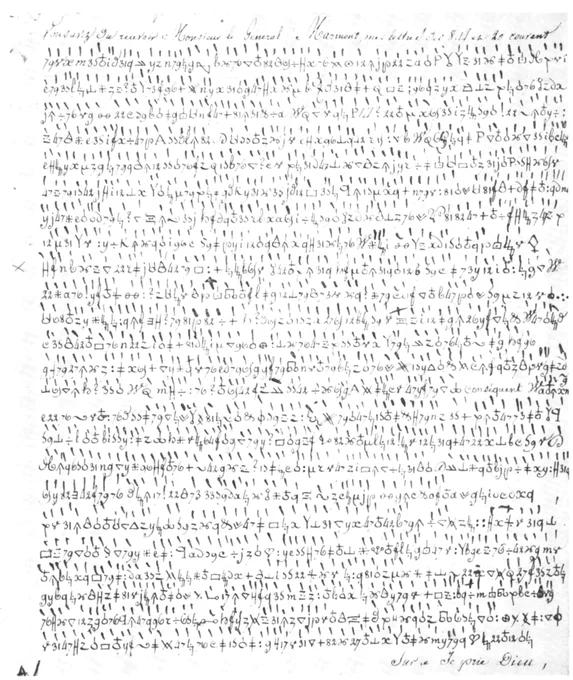
A coded letter sent to Napoleon’s general Auguste Marmont in 1809 has been decrypted with the help of AI. It opens with one line of plain French, then 24 rows of numbers, letters and invented symbols.
The letter was on Satoshi Tomokiyo’s Cryptiana list of unsolved historical ciphers. In September, Tomokiyo reviewed a solution from AI engineer Carter Church and marked it solved.
According to Church, the whole job ran from a single image:
- GPT-6 Astra cut the plate into rows and transcribed 1,300 cipher units, made up of 155 distinct signs.
- A partial table for this cipher, published earlier by French cryptology historian Daniel Tant, gave 33 letter values and unlocked a third of it.
- The rest was cracked with simulated annealing: the solver kept swapping letter assignments and searched for the version that read most like French.
- Cross-checking other letters of the period corrected the published date from 1807 to 1809.
Church says the impressive part isn’t the codebreaking itself. It’s that the whole multi-step workflow was completed from a single image and a goal, in about six hours of model time.
 Carter Church@CarterWChurch
I used GPT-6 Astra to break an unsolved cipher to one of Napoleon's generals that had gone unread for 217 years.
What makes this impressive isn't actually the codebreaking, but that Astra completed the entire multi-modal workflow in ~6 hours from a single image and goal.
1/6🧵
He added a few evenings of his own. To test the result, he reran the solver with Marmont’s memoirs and every Napoleonic text removed from its language model, and it reached the same reading.
The decoded letter is a war briefing sent two weeks before Austria invaded Bavaria. On Napoleon’s orders, Eugène de Beauharnais, Viceroy of Italy, tells Marmont in cipher where every army stands.
It also fills a gap. In Napoleon’s correspondence, printed in 1865, the order has a gap mid-sentence: Marmont mustn’t be pinned down by “a handful of . . .” The cipher letter carries the rest: “a few troops or a gathering of rabble.” It’s a paraphrase, not Napoleon’s exact words, but it’s the first direct evidence of what the dots were hiding.
Church says the cipher itself isn’t hard, and a patient specialist could have cracked it in 1970.
But transcribing, cataloguing, translating and then breaking it would have taken weeks of a specialist’s time across several disciplines. Nobody could justify that time, so the letter sat unread.
Every field has a backlog of unsolved niche problems that specialists don’t have the bandwidth for. Church’s takeaway: the people shortening those lists will increasingly be outsiders who were simply curious.
Still, this is Church’s own account. As far as we know, there’s no published independent review besides Tomokiyo’s, and five signs remain uncertain, though Church says none of them changes what the letter means.
Sources
6 sources
- “Breaking the Marmont Cipher, 1809” · carter.church
- post on X (6-part thread) · x.com
- “Unsolved Historical Ciphers”cryptiana.web.fc2.com
- “Napoleon’s 217-year-old coded message ‘cracked by AI’” · tech.yahoo.com
False claims in circulation
2Claims circulating on social media and elsewhere that did not hold up when checked.
- Claim
- The coded letter was Napoleon’s own message.
- Where
- The Telegraph (Yahoo Tech) (web, Oct. 1, 2026)
- What we found
- On March 16, 1809, Napoleon told his stepson Eugène, the Viceroy of Italy, to send Marmont a letter; the decoded letter was written to that order. According to Carter Church, its content relays Napoleon’s instructions as a paraphrase, not his exact words. [1]
- Claim
- AI decoded the letter on its own in 6 hours.
- Where
- Euronews (web, Oct. 2, 2026)
- What we found
- Six hours was GPT-6 Astra’s execution time. Carter Church writes that he also put in “a few evenings of my own.” [1]
About this story
- Written by
- Yiğit Kasap · JARRUS
- Story date
- On the site
- since Oct. 2, 2026
- @jarrus.tech posted this story on Oct. 2, 2026.
- Short link
thejarrus.com/en/napoleon-cipher- Report an error
- Spotted an error in this story? [email protected] · Instagram