Google publishes an AI system in Nature that spots signs of high blood pressure from smartwatch sensors
In a 196-person study, the system caught 65.8% of people with hypertension and cleared 90% of those without it. Google calls it early research, not a product.
Sources: Nature, Google Research, X +2
The study
A joint study by Google Research, Beth Israel Deaconess Medical Center and Harvard Medical School was published online in Nature on Nov. 5. The paper, “Opportunistically Detecting Signs of Hypertension on a Consumer Smartwatch,” was peer reviewed and accepted. The published text is an accelerated early version that is “subject to further edits” before the final one. The first author is Paolo Di Achille, and the last author is Ming-Zher Poh.
According to Google, hypertension “affects over one billion people globally, yet more than half of adults with the condition are unaware they have it.” Because it rarely causes obvious symptoms, it is usually found through incidental screening. Google says existing commercial cuffless devices usually require regular calibration with a traditional arm cuff. As a result, they track changes from a baseline reading rather than an absolute hypertensive state.
How the system works
The system, called AI-PPG-ACC-HTN, uses two sensors on the smartwatch. An optical pulse sensor (photoplethysmography, or PPG) tracks changes in blood volume at the wrist by measuring reflected light. An accelerometer (ACC) identifies periods of stillness. It also captures the ballistocardiogram (BCG), the subtle vibration of the wrist as the heart ejects blood into the aorta. The system does not estimate point-in-time systolic and diastolic values. It aggregates data over several days and calculates a probability score for a person’s persistent hypertensive state. No cuff calibration is needed.
The model was built in two stages. First, a 1-D convolutional neural network was pretrained with self-supervised learning. It used 492,347 hours of unlabeled sensor data from 2,109 volunteers. The network learned to place overlapping 15-second PPG and accelerometer waveforms from the same person close together. In the second stage, these embeddings are averaged over several days of wear. The person-level embedding, along with the person’s height, is fed into a regularized logistic regression classifier. Google says height serves as a proxy for arterial path length.
 Google Research@GoogleResearch
Today on the blog, we present a new system, published in Nature, that leverages standard consumer smartwatch sensors to passively detect signs of high blood pressure — validated against the clinical gold standard of 24-hour ambulatory bp monitoring. More →goo.gle/4zw2ISD

Clinical results
The system was tested in a prospective clinical study with 196 participants at five U.S. sites. Participants had no known cardiovascular disease and were not taking blood pressure medication. The reference was 24-hour ambulatory blood pressure monitoring (ABPM), and participants were followed for seven days in daily life.
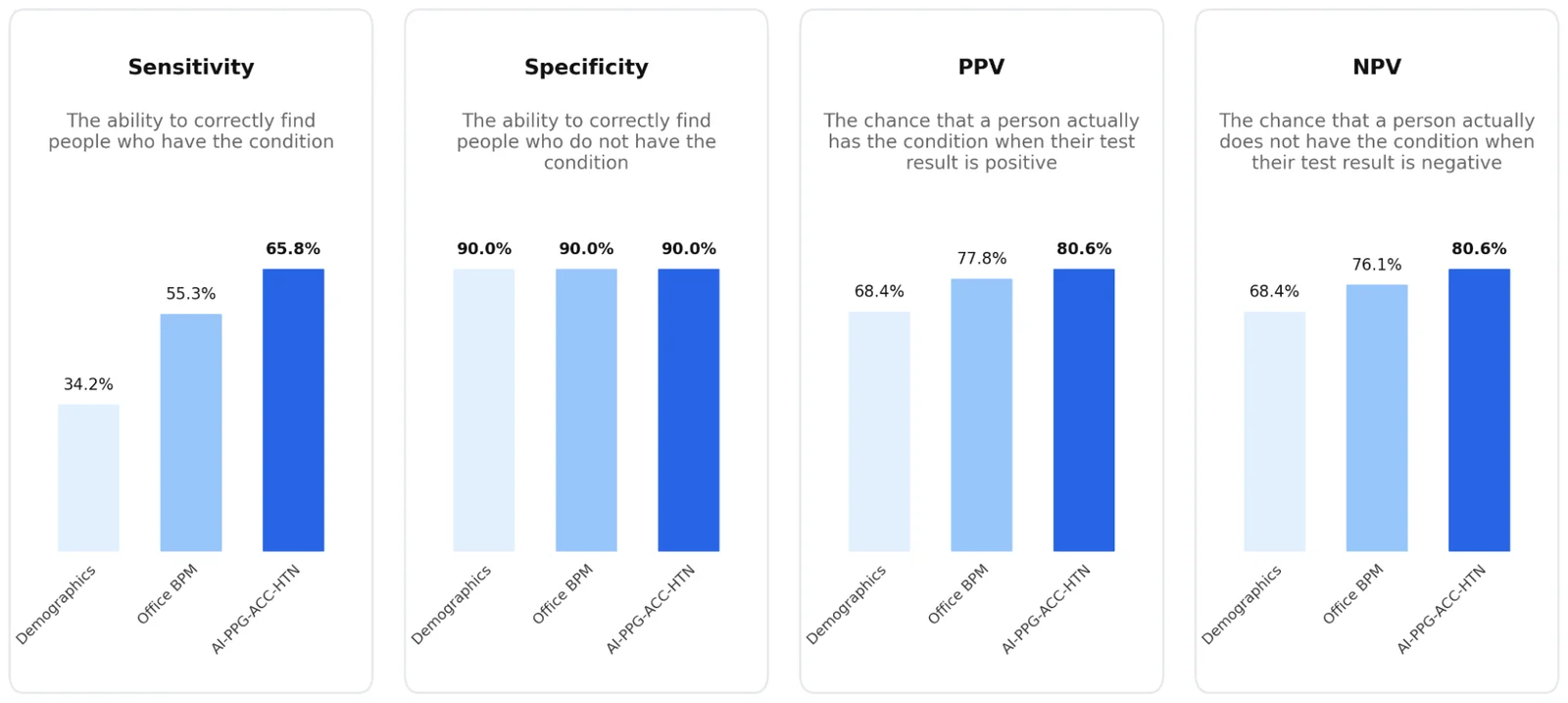
In initial screening, the smartwatch system caught 65.8% of people with hypertension (95% confidence interval 54.0-76.3). It correctly cleared 90.0% of those without it (83.2-94.7). Of those who screened positive, 80.6% actually had hypertension (68.6-89.6). An initial office measurement had the same specificity, with 55.3% sensitivity and a 77.8% positive predictive value. Google’s data show a negative predictive value of 80.6% for the smartwatch system and 76.1% for the office reading. A sensitivity of 65.8% means roughly one in three people with hypertension was missed.
A confirmatory scenario looked at 48 people whose initial office reading was elevated. Here the smartwatch system reached 78.4% sensitivity, 90.9% specificity and a 96.7% positive predictive value. A return office measurement scored 67.6%, 63.6% and 86.2%. Multi-day home monitoring scored 89.2%, 81.8% and 94.3%.
Early research, not a product
Google stresses that the work “represents early feasibility research.” It says the methods “are not indicative of any existing or upcoming commercial product feature or device capability.” Smartwatch-based screening “is not intended to replace standard clinical arm cuffs or provide a definitive standalone medical diagnosis.” The goal is to steer at-risk people toward a formal cuff measurement at a clinic. The paper’s abstract says a “widely available consumer smartwatch” was used; the device model could not be verified because the methods section is paywalled.
Google’s blog post also says the findings helped inform the “blood pressure trends” feature in the Google Health app. That is a separate general wellness feature that is already available. It rolled out free on Sept. 24, 2026, for Google’s third-, fourth- and fifth-generation Pixel smartwatches. According to the Google Health page, it is also on Fitbit Edge and Fitbit Air, where it requires Google Health Premium. According to the help page, the feature relies on the WavesFM model, reports monthly and needs at least five consecutive days of wear. Google says the feature is “not a prescreener for hypertension” and does not diagnose.
Sources
5 sources
- “Opportunistically Detecting Signs of Hypertension on a Consumer Smartwatch”Paper (DOI 10.1038/s41586-026-11336-3, accelerated accepted version): 196 participants, 24-hour ABPM reference, 65.8% sensitivity, 90.0% specificity, 80.6% PPV. · nature.com
- “Detecting signs of hypertension using wearable sensors”Method (492,347 hours of data from 2,109 people), confirmatory-test results and the note that this is early feasibility research, not indicative of a commercial product. · research.google
- “Today on the blog, we present a new system, published in Nature, that leverages standard consumer smartwatch sensors to passively detect signs of high blood pressure”Official announcement post (16:06 UTC) with the system diagram. · x.com
- “Is Your Heart Telling You Something You Can’t Always Feel? Introducing Blood Pressure Trends”Separate product feature: blood pressure trends on Fitbit Edge, Fitbit Air and Pixel Watch 3, 4, 5; for general wellness, ‘not a prescreener for hypertension’. No date on the page.healthapp.google
- “Our new health and safety tools are live in the Google Health app.”Health Guardian features, including blood pressure trends, rolled out Sept. 24 for Pixel Watch 3, 4, 5, with Fitbit Air to follow via Premium. · blog.google
About this story
- Written by
- Yiğit Kasap · JARRUS
- Story date
- On the site
- since Nov. 9, 2026
- Short link
thejarrus.com/en/smartwatch-hypertension- Report an error
- Spotted an error in this story? [email protected] · Instagram