Norway is using laser technology to zap salmon lice
Stingray units spot sea lice with cameras and kill them with lasers; the company has delivered its 4,000th unit, but evidence on effect and welfare is mixed.
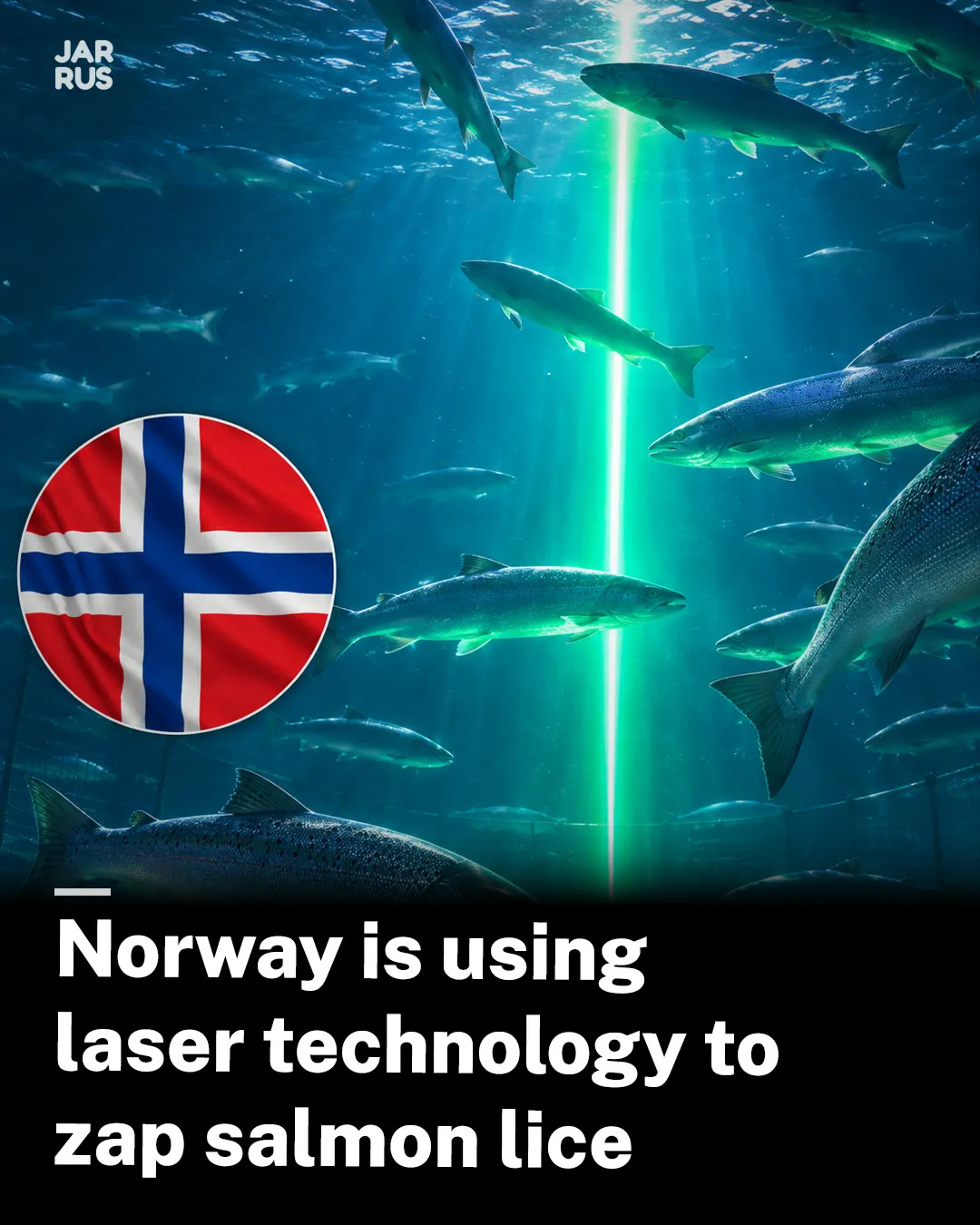
Cover of the Instagram post.
Sources: Stingray Marine Solutions AS, Veterinærinstituttet, Preventive Veterinary Medicine +4
Hunting lice on farmed salmon
One of the biggest problems on Norway’s salmon farms is the salmon louse, a parasite that feeds on the fish’s skin.
Oslo-based Stingray Marine Solutions built a system that hunts these lice with lasers from inside the pen.
Camera, AI, one shot
A unit hanging in the pen watches the fish swimming past with cameras. The company says that when machine learning spots a louse on the skin, a green laser pulse kills it.
The fish aren’t handled and no chemicals are used.
Not 2,000, but 4,000
The 2,000 figure circulating on social media is out of date: the 2,000th unit was delivered in February 2025. On Oct. 21, 2026, the company announced delivering its 4,000th.
By its own data, more than 112 million fish were watched by the system at the end of 2025. The company says it covers 20-25% of Norway’s farmed salmon.
About 15,000 cameras
According to the company’s report, more than 2,500 active units were running in 986 pens on 173 farms at the end of 2025.
Together they carry about 15,000 cameras. The system is used in Norway and Iceland.
Does it work? The evidence is mixed
A University of Bergen analysis done with the company finds 50% fewer lice treatments on laser farms. It isn’t a controlled trial.
An independent 2020 trial by Norway’s Institute of Marine Research found no difference in lice levels between pens with and without lasers. The company says the system wasn’t used as intended in that trial.
Does it harm the fish?
The company presents the system as non-invasive and welfare-friendly. The Norwegian Veterinary Institute’s 2025 report says knowledge of the welfare effects is limited. Preliminary findings show more eye bleeding, mostly mild, in laser pens, and reports of severe cataracts in one eye were recorded; the report also counts lasers as a positive welfare measure where treatments can be avoided.
Sources
9 sources
- “Fish Health Report 2025”The company’s own report (upload path 2026/03): 173 active sites, 986 net pens, 2,500+ active nodes, 20-25% of Norwegian farmed salmon, 112,218,373 fish across 38 customers on 31 Dec 2025, node #2,000 on 5 Feb 2025, node #3,000 on 18 Nov 2025, how the laser works, the company’s response to the 54-day trial, 50% fewer treatments in a University of Bergen model. · stingray.no
- “Laser focus on Sustainability - Sustainability report 2025”How the system works (cameras + machine learning + targeted laser pulse, down to about 20 m), 120+ million fish monitored daily in 2025, 52 billion individual fish recorded, 250 employees. · stingray.no
- “Stingray Marine Solutions - Node 4000 Salaks”The company’s official video and description: node no. 4,000 delivered to Salaks; 3840x1920 source video. · youtube.com
- “Norwegian Fish Health Report 2025”Independent state institute; Norwegian 11 Mar 2026, English 16 May 2026. Laser survey (48 respondents): effective at low lice pressure, weaker at high pressure; severe unilateral cataracts reported; ContrlLaser (FHF 901985) preliminary result: eye haemorrhage (mostly mild) more frequent (p. 108). · vetinst.no
- “Salmon lice survive the straight shooter: A commercial scale sea cage trial of laser delousing”Bui, Geitung, Oppedal, Barrett; peer-reviewed; 54 days at a commercial farm, no difference in mobile lice between cages with and without lasers (the company says the system was not used as intended).pubmed.gov
- “3,500 laser-armed AI submarine robots patrol Norwegian salmon farms, killing sea lice and protecting 112 million fish — parasites get zapped by high-tech alternative to harsh chemical baths”Mark Tyson’s report: citing Stingray’s latest annual report, 3,500+ units, 112 million+ fish, about 1,000 added in a year, 20-25% of Norwegian farmed salmon. The figure could not be checked independently in the report itself. · tomshardware.com
- “Stingray nearly doubles lice laser output as Norwegian demand accelerates”3,063 laser nodes produced (about 1,750 at the 2024 Novo Holdings deal); roughly 35% of sites expected within a year. · salmonbusiness.com
- “Lice-Hunting Underwater Drone Protects Salmon With Lasers”Michael Dumiak: 530 nm green laser, two stereo cameras, reflective fish scales; old, but useful for technical detail. · spectrum.ieee.org
- “Norwegian Fish Health Report 2024”2024 survey: of 75 respondents with laser experience, 17% avoided 1-2 delousing treatments, 8% avoided 3-5, 56% did not know the effect; automatic laser counts can read lower than manual counts (p. 85). · vetinst.no
About this story
- Written by
- Yiğit Kasap · JARRUS
- Story date
- On the site
- since Nov. 20, 2026
- Short link
thejarrus.com/en/norway-salmon-lasers- Report an error
- Spotted an error in this story? [email protected] · Instagram