Hackers set cold rooms at three sites of France’s EFS blood service to 110°C
On the night of Nov. 1-2, cold room settings at France’s blood service EFS were changed via a supplier’s remote monitoring software. Alarms worked; no blood was lost.
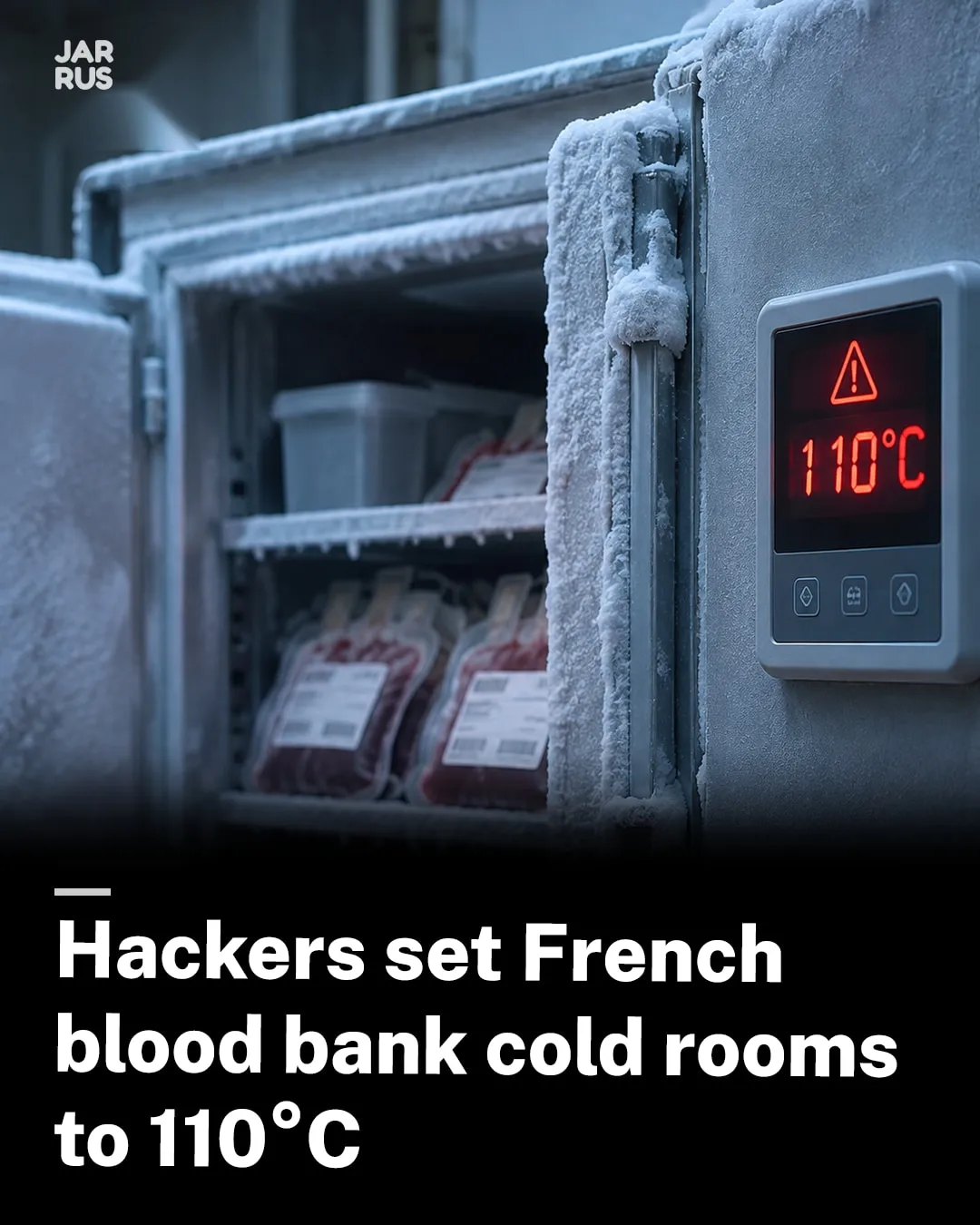
Cover of the Instagram post.
Sources: CERT-FR, Coolworld, franceinfo +13
Cold room settings changed remotely
EFS (Établissement français du sang), France’s national blood service, runs the country’s blood donation and transfusion chain with 13 regional establishments and nearly 10,000 staff. In a statement released Nov. 3, EFS said monitoring and control systems for cold rooms at three regional sites were hit on Monday, Nov. 2. Temperature and defrosting thresholds were raised to “extremely high levels,” it said.
According to Le Canard enchaîné, the weekly that first reported the incident, the attack took place overnight from Nov. 1 to 2. Rooms kept at minus 30 degrees were programmed to reach 110°C, the paper said. That figure is a setting; EFS has not disclosed any measured temperature. The rooms held donor samples, plasma bags for transfusion and plasma for drug manufacturing, which EFS supplies to its partner LFB.
Dr. Christophe Barisien, director of collection and production at EFS Bourgogne-Franche-Comté, told local broadcaster ICI that the affected freezers store products at minus 25 degrees. He said temperatures “went up to 110 or even 150 degrees,” without specifying whether he meant settings or readings.
The attack came through a supplier
According to Politico, EFS was not the direct target. Its statement says the affected rooms were “equipped with the supplier’s solution.” Le Canard, not EFS, named the supplier: Coolworld, a company based in Waalwijk, the Netherlands, that rents out temporary cooling and cold storage.
Coolworld’s Nov. 4 statement, which does not mention EFS, ties the incident to remote monitoring software used in refrigeration systems. The flaw lies in “a component supplied by a third-party provider and not directly controlled by Coolworld,” and only a limited number of units were affected, it said. The component’s maker has not been named. ICI reported that Besançon is one of the three sites; the other two have not been identified.
Alarms and an on-call technician
An EFS spokesperson told Le Canard that an on-call technician noticed the cold store temperature rising overnight from Sunday into Monday. EFS said its monitoring and alarm systems quickly detected the anomalies. According to Barisien, independent temperature monitors flagged the rise, and teams moved the products or regained control of the settings.
EFS says there was no health impact and no loss of blood products. Remote access to the affected equipment was cut, products were moved to other sites as a precaution and monitoring was tightened. Blood collection and distribution continued. EFS president Frédéric Pacoud told BFMTV that samples or plasma bags meant for patients could have been lost.
Health Minister Stéphanie Rist’s office said investigators are examining the method used, the number of devices involved and when the sites can return to service. EFS is working with ANSSI, France’s national cybersecurity agency.
Supermarkets in October, Europe in November
According to Reuters, overnight on Oct. 11-12, fridges and freezers at hundreds of French supermarkets were heated to as high as 50°C, causing fires and spoiling food. Danfoss said the affected units “were running outdated firmware” and, according to The Hacker News, that most were older AK-SM 800 and AK-SC 355 models it no longer updates.
An alert from CERT-FR, France’s government cyber response team, issued Oct. 12 and updated Oct. 16, reports numerous compromises of Danfoss AK-SM and AK-SC controllers and Copeland and Dixell XWEB units. It advises taking the devices off the internet, checking defrost schedules and changing default passwords. For devices without security fixes, it warns, a factory reset is not enough.
According to the BBC, supermarket freezers were hit on the same night as the EFS incident, in Belgium, Luxembourg, Sweden, Ireland, the Netherlands, Estonia and Finland. The Hacker News also listed Portugal and Italy. Belgian refrigeration company Sabcobel said evaporators were switched to defrost mode. Danfoss said the affected Dutch systems were not on a secure network and still used default passwords.
No culprit identified
No one has claimed the attacks. Politico said the EFS incident appears linked to the supermarket wave, but officials have not confirmed a connection. Belgium’s Centre for Cybersecurity said the perpetrators may never be identified. Rafe Pilling of Sophos told The Guardian that state signaling and a lone hacker were the two most plausible scenarios. Because no malware was needed, he said, little trace was left. French digital minister Anne Le Hénanff told the Senate the attacks “have directly targeted our economy and our supply chain.”
What role AI played
There is no claim or evidence that AI was used in the attacks. According to Reuters, officials at the UK’s National Cyber Security Centre (NCSC) said advanced AI probably was not needed, because the attacks targeted known flaws in old technology.
In a Nov. 3 speech, NCSC chief Richard Horne called the fridge attacks “just the foothills.” The issue, he said, is not that AI has invented new ways to attack. Long-tolerated vulnerabilities can now be found and exploited at a scale that was once unimaginable. The NCSC’s annual report says a ransomware attack using AI-powered malware on UK critical infrastructure is highly likely by 2028.
Cover image generated with AI.
Sources
16 sources
- “Incident de sécurité ciblant les contrôleurs à distance des installations de réfrigération”French government alert (CERTFR-2026-ALE-012, updated Oct. 16): numerous compromises of Danfoss AK-SM/AK-SC and Copeland/Dixell XWEB controllers, recommended measures. · cert.cyber.gouv.fr
- “Mise à jour sur la cybersécurité”Supplier statement: the flaw in remote monitoring software lies in a third-party component, a limited number of units affected; EFS is not mentioned. · coolworld-rentals.com
- “Une cyberattaque touche des chambres froides utilisées par l’Etablissement français du sang, “sans impact” sur les échantillons conservés”Direct quotes from the EFS statement, ANSSI and ministry details, Coolworld statement. · franceinfo.fr
- “Cyberattack targets French blood banks”English summary of the EFS statement (with AP): released late Nov. 3, no blood products lost, collection and distribution continue. · lemonde.fr
- “Cyberattaque : des chambres froides de l’Établissement français du sang victimes d’un piratage informatique”The Besançon site and comments by Christophe Barisien, director of collection and production at EFS Bourgogne-Franche-Comté (minus 25 degrees, 110-150 degrees), the ministry’s lines of inquiry. · ici.fr
- “Des chambres froides de l’Établissement français du sang victimes d’une cyberattaque d’un prestataire”AFP report: EFS deputy director general Sophie Le Cam (RTL), ministry investigation, possible link to supermarket attacks. · france24.com
- “Cyberattaque : des chambres froides de l’Établissement français du sang prises pour cible”Night of Nov. 1-2, the minus 30 to 110 degree setting, the on-call technician, EFS president Frédéric Pacoud’s BFMTV quotes. · actu.orange.fr
- “Fridge hacks also hit French blood banks”EFS was not the direct target; Coolworld statement; digital minister Le Hénanff’s remarks in the Senate. · politico.eu
- “France: Cyberattack targets blood bank refrigerators”Same Sunday-Monday wave as in Europe; the ministry disabled remote access. · dw.com
- “French blood service hit by cyber attack threatening to turn stocks into “black pudding””English rendering of Le Canard’s quotes from an EFS spokesperson (on-call technician) and an unnamed EFS source. · itpro.com
- “Shop freezers in seven European countries hit by cyber-attack”Nov. 2 wave: Belgium, Luxembourg, Sweden, Ireland, Netherlands, Estonia, Finland; Sabcobel’s defrost mode explanation. · bbc.com
- “New Wave of Refrigeration Cyberattacks Hits Supermarkets Across Europe, Forcing Stores to Pull Food”Country and store breakdown of the second wave (including Portugal and Italy), Danfoss’s remarks on older models and default passwords. · thehackernews.com
- “Hackers heat French supermarket fridges, sparking fires and spoiling food”October wave: 50°C, fires, Carrefour and Les Mousquetaires figures, Danfoss statement. · arynews.tv
- “Supermarket fridge attack is just the start, says UK cybersecurity chief”AI angle: NCSC says advanced AI probably was not needed for these attacks; Horne’s warning and the NCSC annual report. · bworldonline.com
- “Who is hacking Europe’s supermarket fridges and freezers, and why?”No claim of responsibility; possible culprit scenarios from Sophos’s Rafe Pilling. · theguardian.com
About this story
- Written by
- Yiğit Kasap · JARRUS
- Story date
- On the site
- since Nov. 6, 2026
- Short link
thejarrus.com/en/efs-cyberattack- Report an error
- Spotted an error in this story? [email protected] · Instagram