OpenAI launches ChatGPT Images 2.6 with GIF generation and updated Flare and Sunburst models in the API
Images 2.6 turns prompts or images into GIFs and saves reference images. OpenAI says it is 50% faster, and API token prices match version 2.5.
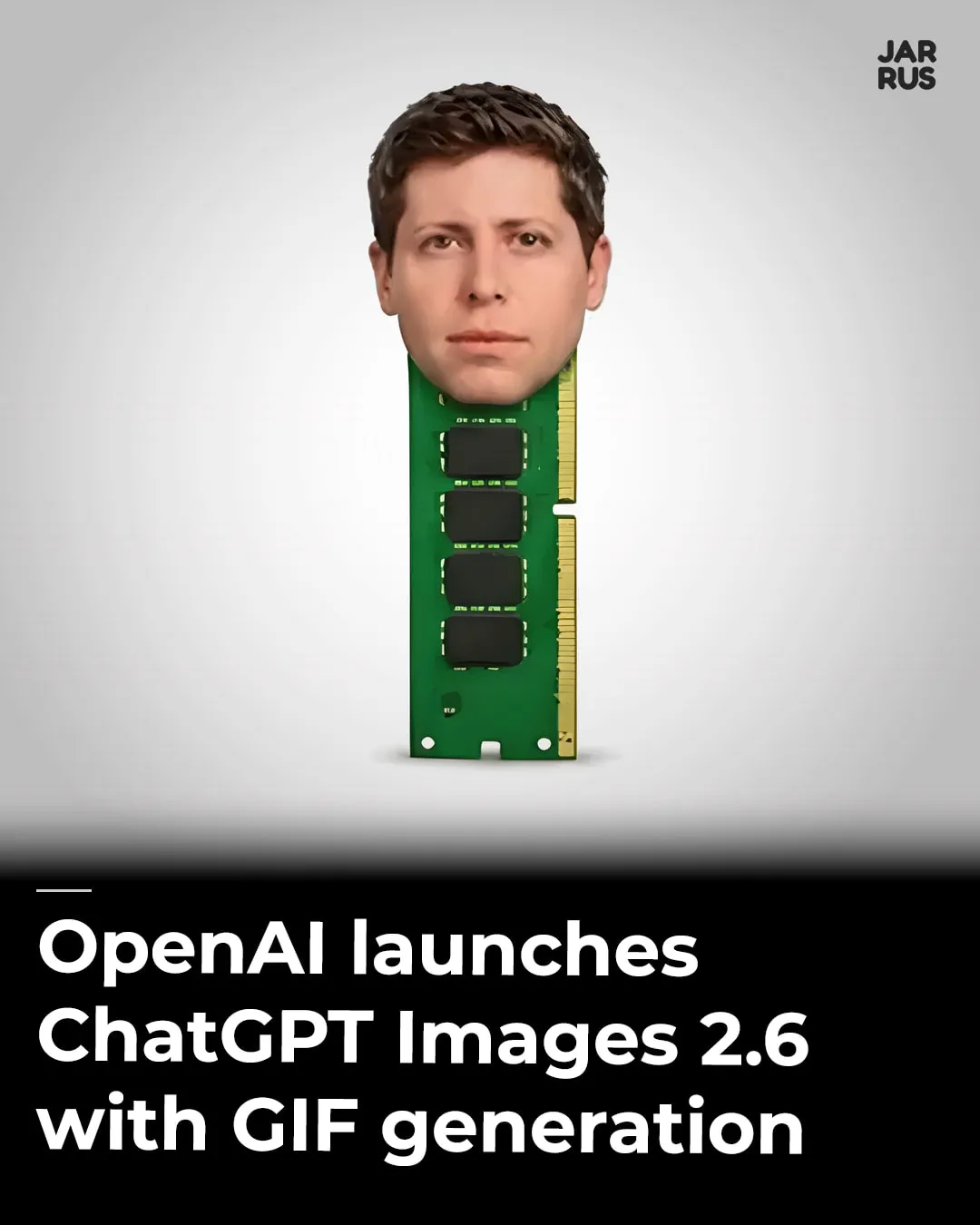
Cover of the Instagram post.
Sources: OpenAI, OpenAI Developers, OpenAI Deployment Safety Hub +4
GIFs and saved references in ChatGPT
OpenAI announced Images 2.6 on Nov. 4, and its launch post on X went up at 11:35 p.m. UTC. The update is available globally in ChatGPT and Codex on every subscription tier, across web, desktop and mobile. Developers get two API models, GPT-Image-2.6 Flare and Sunburst.
OpenAI says Images 2.6 generates images 50% faster than before, without saying which version or setting it is compared with. The company also said people now create 4 billion images a week across ChatGPT, Codex and the API. The launch post had more than 2.6 million views as of Nov. 6.
 OpenAI@OpenAI
Images, upgraded—introducing ChatGPT Images 2.6.
Now with GIFs and reference images.
Plus, two new models are coming to the API with 50% faster image generation.

How the GIFs work
In ChatGPT, a prompt or an uploaded image can be turned into an animated GIF. According to OpenAI, users can adjust the speed and edit individual frames. The tech site heise online reported that the feature is rolling out gradually in ChatGPT.
In the API, developers set the output format to “gif.” OpenAI’s developer guide says a GIF can have 2 to 16 frames, 9 by default, and each frame lasts 20 to 2,000 milliseconds, 200 by default. That makes the default output a loop of about 1.8 seconds.
OpenAI pitches GIFs for brand mascots, reactions and memes, and for testing character movement before video production. In OpenArt’s examples in the announcement, the model is asked for a single sprite sheet of 6 frames in a 3-by-2 grid.
OpenAI@OpenAIGIFS!
With ChatGPT Images 2.6, turn a prompt or image into an animated GIF.
Adjust the speed, edit individual frames, and share it on repeat.

References, markup and a complexity setting
Users can save reference images of themselves, their pets and characters and reuse them without uploading them again. According to heise online, saved photos can be named and called up in later chats.
Image markup, already in ChatGPT, now comes to the API. Developers mark the area to change on a transparent PNG layer the same size as the original, at no extra fee. A new “complexity” parameter sets how much planning the model does for a request. It takes low, medium or high, with high as the default. The guide warns that higher settings can increase latency and introduce unwanted changes. According to the system card, ChatGPT offers a similar reasoning control in the model picker.
Flare and Sunburst in the API
The Flare and Sunburst names are not new. According to heise online, Images 2.5 brought both variants to the API just under two months earlier, and 2.6 updates them. OpenAI says GPT-Image-2.6 Flare can generate an image in as little as six seconds at low quality and handles layouts for posters and product images better. Sunburst targets more detailed images and more consistent edits at medium and high quality.
SVG output is API-only. Per the guide, the API first generates a reference image, then a separate model turns it into an editable vector file, so developers pay for both models. Early access customers included Picsart, fal, Sable and Higgsfield, and Figma Weave is adding the model to its platform.
OpenAI@OpenAITwo new image models for developers: GPT-Image-2.6 Flare and Sunburst.
Flare generates images in as little as six seconds. Sunburst brings higher-quality generation and greater consistency across edits.
Image markup and SVG exports give you more ways to refine and use what you create.

Same token prices, unclear cost per image
OpenAI’s pricing page lists both 2.6 models at the same rates as the 2.5 models and GPT Image 2.
Price per 1 million tokens (Flare and Sunburst)
- Image output: $30
- Image input: $8 ($2 cached)
- Text input: $5 ($1.25 cached)
The same token price does not mean the same cost per image. OpenAI notes that the models can use different numbers of tokens at the same quality setting, and it publishes no per-image dollar table for 2.5 or 2.6. For comparison, a 1024x1024 image from GPT Image 2 costs $0.006 at low quality, $0.053 at medium and $0.211 at high.
Safeguards and watermarks
According to the system card, Images 2.6 builds on the safety stack of Images 2.5. Requests pass LLM-based policy checks, and a safety reasoning model then reviews both the inputs and the output image. Extra rules cover GIFs, since motion can carry risks a single frame does not show, such as sexualized movement. OpenAI says such violations remain hard to detect and may not all be caught.
In OpenAI’s test of 3,077 adversarial requests, the share of violating images that got past moderation fell from 1.92% to 1.72% for Sunburst. For Flare, it rose from 1.49% to 2.14%, a difference OpenAI calls not statistically significant. Before moderation, the share of Flare outputs graded safe fell from 78.36% to 75.04%, a significant decline. Images carry C2PA metadata and Google DeepMind’s invisible SynthID watermark.
Early reactions and known limits
Some replies to the announcement pointed to existing flaws. A user named PJ Ace wrote that a sepia wash, artifacts and “muddy noise” make the model unusable for professional work. Another user, Smoke-away, said images drift after many edits. OpenAI’s guide also says the model can struggle with precise text placement, consistent recurring characters and layout-sensitive compositions.
About 25 minutes after the launch post, a user named Danny replied with a “Ram Altman” GIF. It shows Sam Altman’s head on top of a RAM module. Altman had briefly taken that display name on X on Nov. 4, after backlash over his remarks about memory. Danny did not say which tool made the GIF.
Sources
13 sources
- “Introducing Images 2.6”Announcement: GIFs, 4 billion images a week, the 50% speed claim, Flare and Sunburst, complexity, markup, SVG, OpenArt examples, early access customers, availability · openai.com
- Launch post and video · x.com
- Saving reference images · x.com
- “Image generation”GIF parameters, SVG process and cost, complexity, markup limits, GPT Image 2 per-image prices, known limitationsdevelopers.openai.com
- “ChatGPT Images 2.6 System Card”Safety layers, GIF risks, the 3,077-request test, C2PA and SynthID, reasoning effort in the model picker · deploymentsafety.openai.com
- “ChatGPT Images 2.6 adds GIFs, SVGs and speed”The gradual GIF rollout, naming saved references, Flare and Sunburst arriving with Images 2.5 · heise.de
About this story
- Written by
- Yiğit Kasap · JARRUS
- Story date
- On the site
- since Nov. 5, 2026
- @jarrus.tech posted this story on Nov. 5, 2026.
- Short link
thejarrus.com/en/chatgpt-images-2-6- Report an error
- Spotted an error in this story? [email protected] · Instagram