Safety and securityCompanies and people
Binance says attackers behind its $6.34 billion heist used fake job interviews and an internal AI tool
Binance’s initial report says the attack began in June. The AI tool helped attackers move between engineers; it was not the system that signed transactions.

Cover of the Instagram post.
Sources: Binance, Richard Teng, Yi He +15
In this story
- Binance’s initial incident report
- June: a tampered Homebrew installation
- September: a fake interview and a…
- Oct. 20: the internal AI tool
- Oct. 29: the signing service and…
- The numbers: $6.34 billion, with…
- Attribution: the FBI and North…
- The largest crypto heist on record
- No mention of the fake Claude Code…
- Sources19
- About this story
- Related2
Binance’s initial incident report
On Nov. 3, Binance published its initial incident report on the Oct. 29 attack as an article on its own X account. According to the report, it was not a single isolated breach or a simple phishing incident. The attackers combined social engineering through fake recruitment interviews, malicious software downloads, compromised internal AI tooling, endpoint compromise and an advanced transaction-authorization method.
Binance calls the document an initial report: the investigation is ongoing, the findings will be subject to further independent review and some technical details will remain confidential. Co-CEO Richard Teng wrote on X the same day that this was not one mistake or one breach but a months-long campaign. In a live interview on CNBC, Teng also described the fake developer tool in June and the fake job interviews in September, and said an independent expert would review everything the company has done.
 Richard Teng@_RichardTeng
On 29 October, Binance was the target of one of the most sophisticated attacks the digital asset industry has ever seen. ~$6.34B in assets were impacted. We take full responsibility and we're making it right.
No user bears the loss. We set aside more than the full amount required. At this moment, 98% of impacted tokens had been replenished; we're completing the remaining 2%. Withdrawals have broadly resumed.
This wasn't one mistake or one breach - it was a months-long campaign. We're publishing the full report because the lessons go far beyond Binance.
~$2.85B has already been frozen or intercepted with law enforcement, issuers and blockchain intelligence firms. The speed of coordination could not be matched in traditional finance.
June: a tampered Homebrew installation
The first step in the report is a supply-chain attack. A Wallet DevOps engineer on Binance’s wallet infrastructure team (“Engineer A” in the report) downloaded a tampered Homebrew installation found through a search engine while trying to install a popular AI coding tool. Homebrew is a widely used package manager for installing software on macOS. The security team spotted the anomaly, replaced the device and rotated credentials. According to the report, the engineer’s role and colleagues on the wallet infrastructure team were nonetheless exposed to the attacker.
Binance doesn’t name the coding tool. At this step the report links to an April 30 write-up by the SANS Internet Storm Center about an infostealer spread through a fake Homebrew ad, without saying it was the same campaign. The company also says its security team detected and blocked 57 suspected North Korea-linked cyber threat cases in 2026. They involved fraudulent job interviews, malware disguised as popular developer tools, compromised software packages and browser extensions, and fake video-conferencing apps.
September: a fake interview and a malicious “assignment”
In September, someone posing as a project director, with Binance experience listed on their profile, approached another software engineer (“Engineer B”) through a legitimate job-hunting platform. The first round was a live video call with a fake HR representative. To build trust, the attackers shared a social media account with personal photos and videos; Binance describes the setup as more advanced and deceptive than previously seen. The second round took place with the fake company’s “CEO” on a popular social chat app, and ended with the engineer being asked to download an “assignment” to a work computer.
The code ran during installation and replaced a legitimate development tool component with a malicious version. The report walks through the steps using pyenv, the Python version manager: the real pyenv file in the Homebrew directory was deleted and a fake one was put in its place under the same name. According to the report, endpoint security tools didn’t detect this zero-day malware at the time, and the attacker also wiped traces.
Oct. 20: the internal AI tool
From Engineer B’s compromised computer, the attacker used an internal AI tool as a springboard to gain control over the computers of Engineer A and another wallet software engineer (“Engineer C”). The attacker then found a container deployment permission token on Engineer A’s computer.
Binance hasn’t disclosed the tool’s name, maker or type, or how control was gained through it. According to the report, the tool helped the attacker move between engineers; it was not the system that approved or signed the transactions. The company rebuilt the affected tool and its access controls.
On Nov. 4, co-CEO Yi He wrote that many professionals had advised against including details in the report, but that the company believes transparency creates trust. According to Yi He, if the report is of reference value to peers on the complexity of social engineering and the warning about AI permission boundaries, then it is meaningful. Binance has restructured security boundaries across departmental access management, security environments and devices, and reset its AI tools, following zero-trust and least-privilege principles. Yi He added that a security audit will later issue its own report.
 Yi He@heyibinance
Regarding criticism and suggestions about Binance’s security and access management, we accept them all. We have always believed that transparency builds trust. We read every comment one by one. Binance is not a perfect company, but a company that is constantly evolving. Criticism shows that people have expectations and standards for Binance, and these are sources of motivation for our growth.
Binance has never shirked responsibility where problems exist. At present, as a trading platform, Binance needs to address three issues:
1)Will users’ funds be affected? Binance will bear full responsibility,this is what we should do. Legally, if the funding gap is large, one could file for bankruptcy and run away, but Binance operates in a “user-centric” way, with contractual spirit and a sense of moral responsibility.
2)How did the problem occur? Before publication, many professionals advised that it would be best not to include details, but we believe transparency creates trust. If this report is of reference value to other peers regarding the complexity of social engineering and the warning about AI permission boundaries, then the report is meaningful.
3)How can it be prevented in the future? We have already restructured security boundaries across departmental access management, security environments, updated devices, reset AI tools, and in accordance with zero-trust and least-privilege principles. A security audit will subsequently issue a report.
Finally, we welcome more top AI security experts and technical talent to join Binance. You can DM me directly or apply on the Binance website for positions you are interested in. Joining Binance to verify this security system is the best way to validate it.
关于对币安的安全和权限管理的批评建议,我们都认。我们一直相信坦透明会建立信任,大家的评论都有一条一条看,币安不是完美的公司,但是一个一直在进化的公司,批评说明对币安有期望,对币安有标准,这些都是我们成长的动力源泉。
币安有问题的地方也从来没有推卸过责任。当下,币安作为交易平台需要解决三个问题:
1)用户的钱会不会受影响?币安会完全承担,这是我们应该做的。法律上资金缺口大可以申请破产跑路,但币安经营是“以用户中心”,是契约精神和大义。
2)问题是怎么发生的?发布前很多专业人士的意见是最好没有细节,但我们认为透明产生信任,如果这个报告在社会工程的复杂度,在AI权限边界的警示对其他同行有参考意义,那么这个报告就有意义。
3)以后如何杜绝?当前已经从各部门权限管理,安全环境,更新设备,重置AI工具,并遵循0信任、最小化原则重构安全边界,后续会由安全审计出具报告。
最后欢迎更多顶尖的AI安全专家和技术人才加入币安,您可以直接DM我本人,也可以在币安网站申请你感兴趣的岗位。加入币安来验证这套安全体系是最好的验证办法。
Oct. 29: the signing service and EIP-7702
According to the report, between 17:15 and 19:56 on Oct. 29 (the report doesn’t give a time zone) the attacker logged onto Engineer C’s computer, used credentials stolen from Engineer A to deploy a container, and triggered the malicious script that launched the attack. That gave the attacker unauthorized access to an internal wallet signing service and the ability to initiate transactions outside the normal withdrawal process.
The first transfer left at 8:05 p.m. UTC, on XRP: five hot wallets sent 233.46 million XRP within about four minutes. About 970,500 SOL and 44.2 million OP left on Solana and Optimism, and the Bitcoin hot wallet sent 18,270 BTC. On Ethereum, the attackers submitted 50 signing transactions through the signing service to manipulate the account nonce and establish malicious EIP-7702 delegation authorizations. EIP-7702 is the mechanism that lets an ordinary Ethereum account delegate its execution rights to a smart contract.
Binance says halting withdrawals wasn’t enough, because those authorizations were already on-chain. Since the wallets are protected with MPC (multi-party computation) and have no single private key, revoking them required a special procedure. The last unauthorized transfer, 2,961.9 ETH, went out at 11:56 p.m. UTC. At 12:10 a.m. UTC on Oct. 30, the affected wallet’s delegation was cleared by pointing it to the zero address.
Blockchain analytics firms describe the same picture. According to TRM Labs, the 50 authorizations were submitted in a single transaction; 3 minutes and 24 seconds later the wallet sent its entire balance, 63 tokens including 167,464 ETH and 1.615 billion USDT. Elliptic says $2.53 billion of the Ethereum losses left in a single transaction. TRM says preparation began at least 36 hours before the theft: the attacker’s operator wallet received small withdrawals from Tornado Cash from the morning of Oct. 28, the attack code was tested on two wallets on Oct. 29, and the final version was rehearsed on a third.
The numbers: $6.34 billion, with $2.85 billion frozen
Binance puts the impacted assets at about $6.34 billion. Other estimates vary with the prices used: TRM Labs says $6.36 billion, Chainalysis about $6.4 billion and Elliptic $6.43 billion, while the FBI says more than $6 billion. Binance says about $2.85 billion has been frozen or intercepted together with law enforcement, token issuers and blockchain intelligence firms.
The affected wallets were Binance’s own hot wallets. The company says it found no evidence of a private key leak and that users will not bear the loss. On Oct. 30, Binance set aside $6.34 billion of company funds to cover it, drawn from part of its SAFU user protection fund, part of its futures insurance fund and the company treasury. As of Nov. 3-4, the company says about 98% of the affected tokens had been replenished. Withdrawals were halted on Oct. 29 and gradually reopened on Nov. 1.
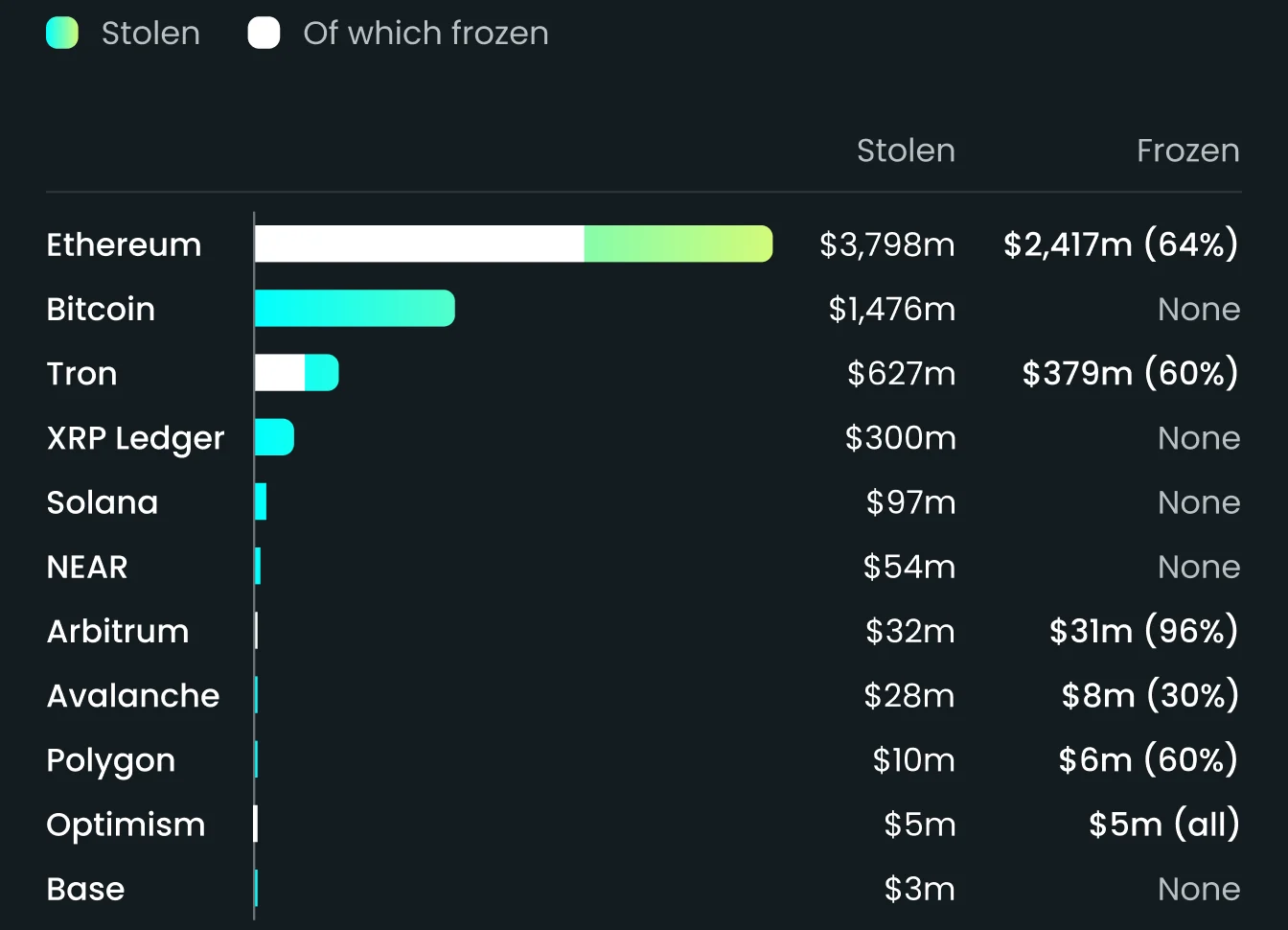
By Elliptic’s count, 82% of the stolen funds were taken on Ethereum and Bitcoin. Some 64% of the funds taken on Ethereum have been frozen, while none of the Bitcoin has.
Attribution: the FBI and North Korea’s denial
On Oct. 31, the FBI said North Korea was responsible for the theft of more than $6 billion in virtual assets from Binance on or about Oct. 29, and referred to the activity as “TraderTraitor.” According to the FBI, the attackers converted the stolen assets mainly into ETH, and the funds are expected to keep being laundered through DeFi and instant-exchange services. The FBI, the U.S. Secret Service and IRS Criminal Investigation asked private-sector firms to block transactions involving addresses linked to the attackers and published the list. Binance cites this FBI information in its report.
Chainalysis and TRM Labs also attribute the attack to TraderTraitor with high confidence. One of Chainalysis’ grounds is that funds stolen from Bitget in September were commingled on-chain with the Binance funds at the same address. After the FBI’s statement, Elliptic wrote that it had also assessed TraderTraitor as the likely perpetrator.
North Korea rejected the accusation. In a statement made on Nov. 2 and carried by the state news agency KCNA on Nov. 3, Kim Yo Jong, a department director of the Workers’ Party Central Committee, called the U.S. assertion “an absurd rhetoric and nothing new” and the renewed link to North Korea “a trite provocation.” In a second statement on Nov. 4, Kim Yo Jong said Pyongyang does not regard the incident as an accidental case or an isolated private scheme, but as an extension of Washington’s unchanging hostile policy toward North Korea.
The TraderTraitor name and playbook aren’t new. According to an April 2022 joint advisory from CISA, the FBI and the U.S. Treasury, these attacks start with messages to system administrators or DevOps staff at crypto companies that mimic a recruitment effort and offer high-paying jobs. The FBI, the Department of Defense Cyber Crime Center and Japan’s National Police Agency say that in the $308 million DMM Bitcoin theft in May 2024, an actor posing as a recruiter on LinkedIn sent an employee of Ginco, a Japanese enterprise crypto wallet software company, a malicious Python script disguised as a pre-employment test. On Nov. 3, Chainalysis said it had attributed more than $14.3 million in losses over the past 18 months to similar North Korea-linked fake interview and malware schemes. Binance hasn’t tied the incident to a specific named campaign.
 FBI Cyber Branch@FBICyberBranch
The FBI is releasing information advising the Democratic People's Republic of Korea (North Korea) was responsible for the theft of more than $6 billion USD in virtual assets from cryptocurrency exchange, Binance, on or about October 29, 2026. The FBI refers to this specific North Korean malicious cyber activity as "TraderTraitor."
The FBI, together with partners at the USSS and IRS-CI, has observed TraderTraitor actors converting stolen assets primarily into Ethereum (ETH). It is expected these assets will then be further laundered by converting them using DeFi and instant swap services as they prepare them for further laundering stages.
How You Can Help:
FBI, USSS, and IRS-CI are urging private sector entities including THORNode operators, RPC node operators, instant exchanges, DeFi services, blockchain analytics firms, and other virtual asset service providers to block transactions with or derived from addresses TraderTraitor actors are using to launder these stolen assets.
A list of addresses associated with this activity is available here: fbi.gov/investigate/cyber/alerts/2026/north-korea-responsible-for-6-billion-binance-attack

The largest crypto heist on record
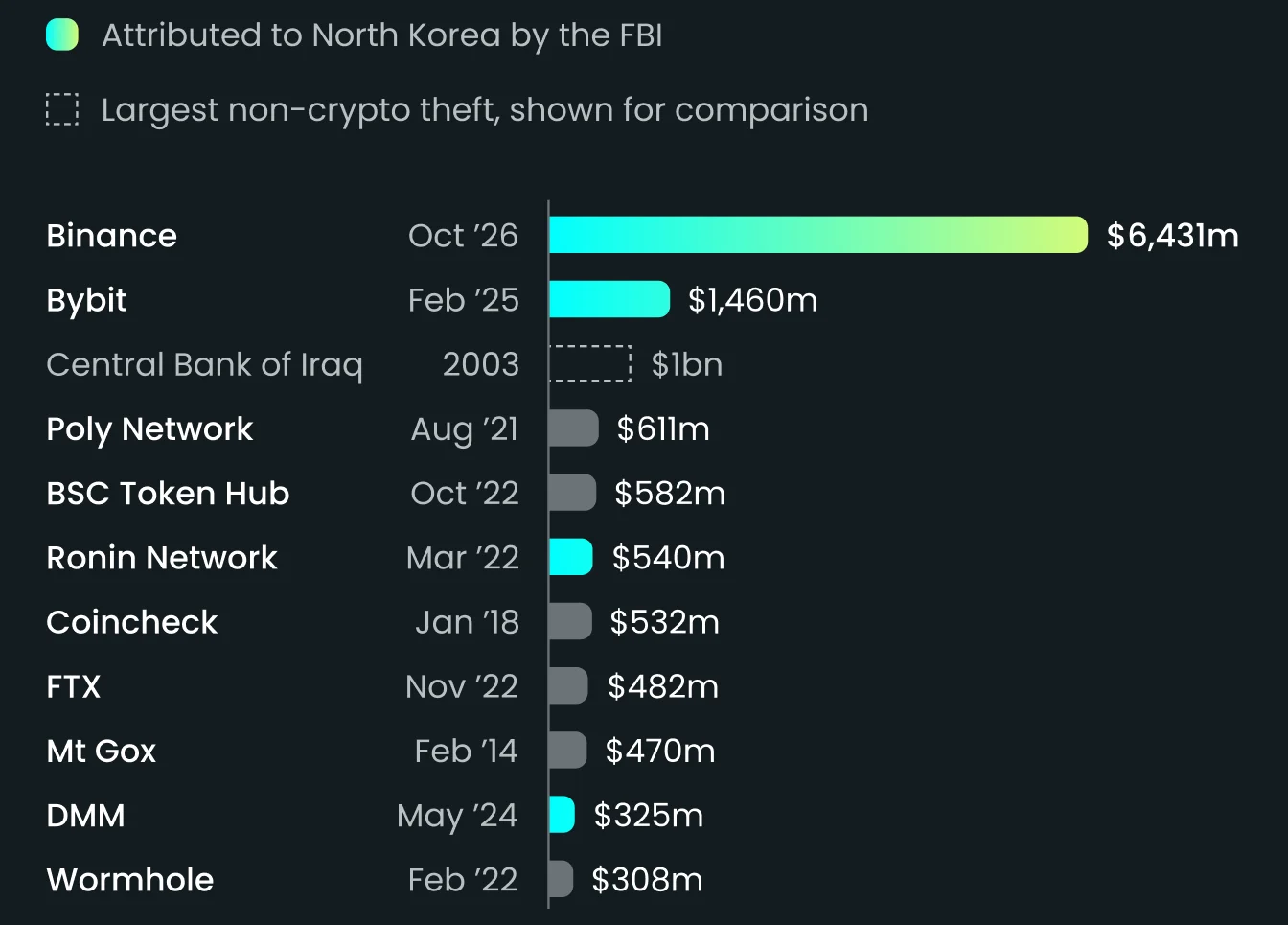
According to Elliptic, the Binance theft is 4.4 times the size of the previous record, the $1.46 billion Bybit hack of February 2025, which the FBI also attributed to TraderTraitor. Four of the ten largest crypto heists on Elliptic’s list have been linked to North Korea by the FBI. Chainalysis says North Korea-linked hackers stole at least $2.02 billion in crypto in 2025, bringing their all-time total to at least $6.75 billion; the roughly $6.4 billion moved in the Binance hack alone equals 95% of that total.
Binance founder Changpeng Zhao (CZ) wrote on Nov. 4, as a shareholder, that a hack of this scale means serious security failures occurred, and that no platform is unhackable but that cannot be an excuse. According to CZ, public explanations simplify what appears to have been a prolonged attack lasting months or even years, targeting hundreds of employees and systems, with a few ultimately compromised. The report gives no figures on that scope.
 CZ 🔶 BNB@cz_binance
A hack of this scale means serious security failures occurred. No platform is unhackable, but that cannot be an excuse. Every incident exposes weaknesses that should have been prevented.
Some details are embarrassing. Public explanations also simplify what appears to have been a prolonged multi month/year attack targeting hundreds of employees and systems, with a few ultimately compromised.
Sharing those details, however uncomfortable, helps the wider industry learn.
As a shareholder, I expect Binance to be transparent about what went wrong, take responsibility, learn from all criticism, and make meaningful improvements. 🙏
Thanks @binance for sharing all these details. Incredibly helpful to the entire industry.
Binance has brought in independent cybersecurity firms to review the incident; a final report on the root cause hasn’t been published yet. In the report, the company also committed to investing in AI security, setting up a security research fund and launching targeted initiatives with leading AI companies.
No mention of the fake Claude Code extension
The attack fell on the same day a tampered version of the Claude Code extension was distributed on Cursor’s extension marketplace, and people on X asked whether the two were connected. Binance’s report doesn’t mention the extension; Claude Code, Cursor and Anthropic don’t appear in it. The attack chain it describes began weeks before the malicious versions 2.1.312 and 2.1.313 were on the marketplace between 9:27 a.m. and 8:35 p.m. UTC on Oct. 29: the entry came through the fake interview assignment in September, and the move through the AI tool and the discovery of the container token happened on Oct. 20.
If the Oct. 29 session, for which the report gives no time zone, was in UTC, it overlaps with the hours the extension was live, but Binance attributes that session to credentials stolen earlier from Engineer A. The June step wasn’t an extension either, but a tampered Homebrew installation.
Cover image generated with AI.
Sources
19 sources
- “29 October Binance Security Incident: Initial Findings and Response Update”Binance’s initial incident report (X article): the tampered Homebrew install in June, the fake interview and malicious assignment in September, the internal AI tool on Oct. 20, the Oct. 29 timeline, EIP-7702, the $6.34B and $2.85B figures, and remediation steps · x.com
- “North Korea Responsible for $6 Billion+ Binance Attack”The FBI’s attribution to North Korea’s TraderTraitor, the conversion of funds into ETH and the list of linked addresses · fbi.gov
- “Press Statement of Kim Yo Jong, Department Director of C.C., WPK”Kim Yo Jong’s statement, released on Nov. 2 and carried by KCNA on Nov. 3, rejecting the FBI’s accusation · kcna.kp
- “The $6.4 Billion Binance Hack: Tracing the North Korea Link”On-chain analysis: when outflows began, TraderTraitor attribution and commingling with Bitget funds, the race against freezes and automated laundering (updated Nov. 5) · chainalysis.com
- “DPRK Hackers Perfected Their Fake Interview Playbook Over Dozens of Attacks Before Binance”North Korea’s fake interview playbook: more than $14.3M in losses over 18 months attributed to similar schemes, ‘contagious interviews’ and command infrastructure hidden on blockchains · chainalysis.com
- “North Korea Steals USD 6.36 Billion From Binance in the Largest Hack in History”Chain-by-chain breakdown, preparation that began at least 36 hours earlier, the 50 pre-signed EIP-7702 authorizations, evidence pointing to the signing infrastructure, and freezes · trmlabs.com
- “The largest theft in history: North Korea behind the $6.4 billion Binance hack”The $6.43B estimate, the comparison with the largest heists, stolen and frozen funds by blockchain, and automated laundering (last updated Nov. 1) · elliptic.co
- “Binance co-CEO Richard Teng says hackers used fake job interviews, AI tool to steal $6.3 billion in crypto”Teng’s comments on Squawk on the Street: the fake developer tool in June, the fake interviews in September, 98% replenished and an independent review · cnbc.com
- “A hack of this scale means serious security failures occurred.”The Binance founder’s comment as a shareholder: serious security failures, and public explanations simplifying a months- or years-long attack · x.com
- “North Korean hackers stole at least $2.02B in crypto in all of 2025, bringing their all-time total to at least $6.75B.”North Korea-linked hackers’ 2025 and all-time totals; the Binance hack equal to 95% of that total · x.com
- “Press Statement of Kim Yo Jong, Department Director of C.C., WPK”Kim Yo Jong’s second statement on Nov. 4: the incident as an extension of Washington’s hostile policy · kcna.kp
- “Malicious Ad for Homebrew Leads to MacSync Stealer”The example write-up Binance’s report links to at the June tampered-Homebrew step (not said to be the same campaign) · isc.sans.edu
- “TraderTraitor: North Korean State-Sponsored APT Targets Blockchain Companies”Joint CISA, FBI and U.S. Treasury advisory (AA22-108A): TraderTraitor attacks starting with messages that mimic recruitment · cisa.gov
- “FBI, DC3, and NPA Identification of North Korean Cyber Actors, Tracked as TraderTraitor, Responsible for Theft of $308 Million USD from Bitcoin.DMM.com”The DMM Bitcoin theft: a LinkedIn message from a fake recruiter and a malicious Python script disguised as a pre-employment test · fbi.gov
- “North Korea Responsible for $1.5 Billion Bybit Hack”The FBI’s public service announcement attributing the Bybit hack to TraderTraitor · ic3.gov
About this story
- Written by
- Yiğit Kasap · JARRUS
- Story date
- On the site
- since Nov. 7, 2026
- Short link
thejarrus.com/en/binance-heist- Report an error
- Spotted an error in this story? [email protected] · Instagram