Alphabet lost $500 billion in a day and OpenAI cut its funding goal: AI money is cooling
Alphabet lost $500 billion in a day and OpenAI cut its goal to $20 billion. Four giants plan $730 billion in spending this year as cash runs short.
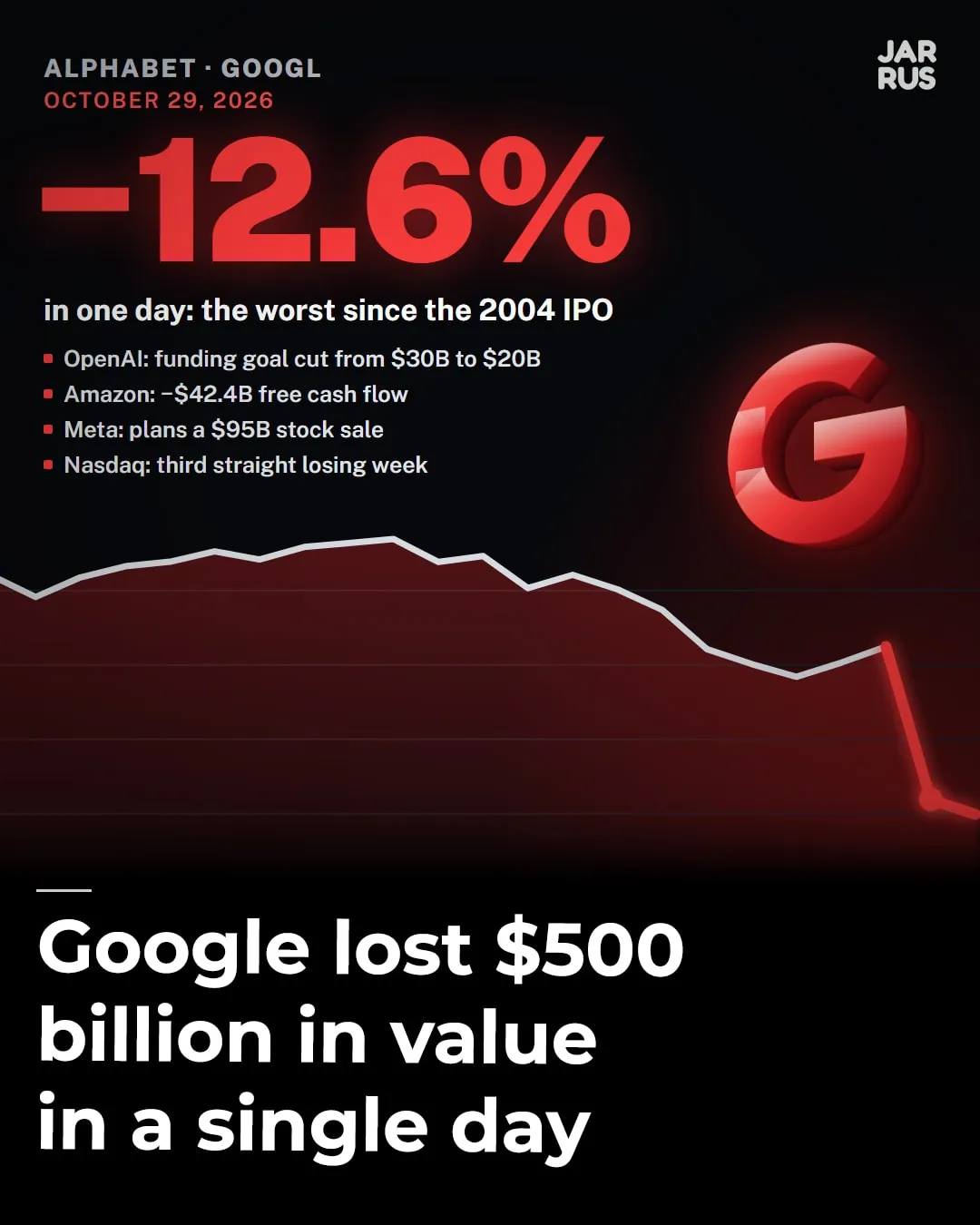
Cover of the Instagram post.
Sources: Investing.com, CNBC, Amazon +6
Alphabet’s worst day ever
Alphabet shares (GOOGL) fell 12.6% on October 29, from $324.89 to $283.82, after the company reported third-quarter results on the evening of October 28. CNBC says it was the steepest one-day drop since Google’s 2004 IPO, wiping out about $500 billion in market value; the previous record was 11.63% in March 2020. The stock slipped another 1.4% on October 30 to close at $279.84, ending October down 18.7%.
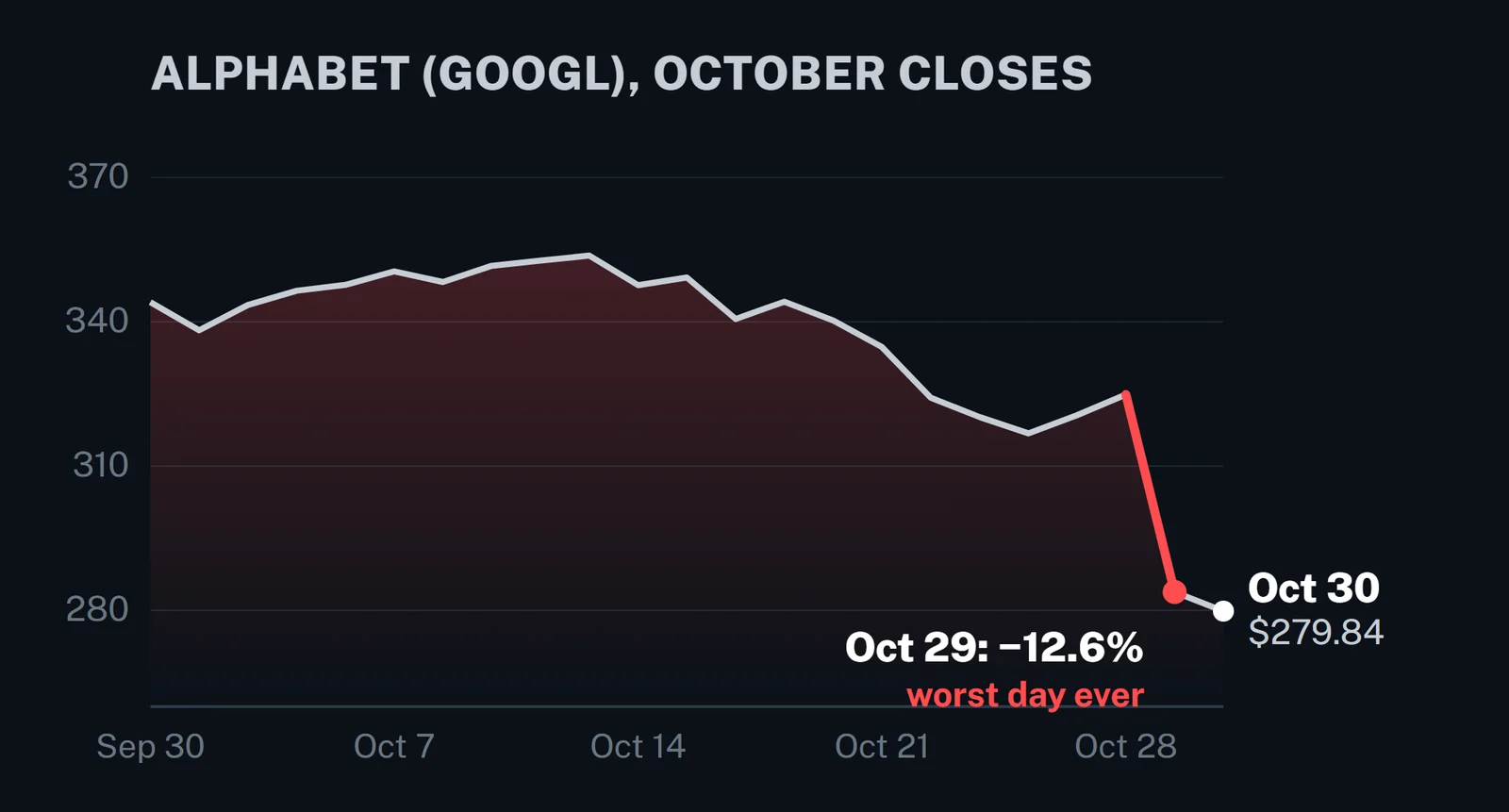
Cash flow was the main trigger. Alphabet reported negative free cash flow of $9.07 billion for the third quarter, while analysts expected a positive $2.7 billion. The company kept its 2026 capital spending forecast at $195 billion to $205 billion. Search advertising, its largest revenue source, rose 12% to $63.35 billion but missed estimates. Finance chief Anat Ashkenazi said outside computing power “came online only at the very end of Q3.” Ben Barringer of Quilter Cheviot called it a “fairly messy set of results and a poorly handled earnings call.”
OpenAI cuts its funding goal to $20 billion
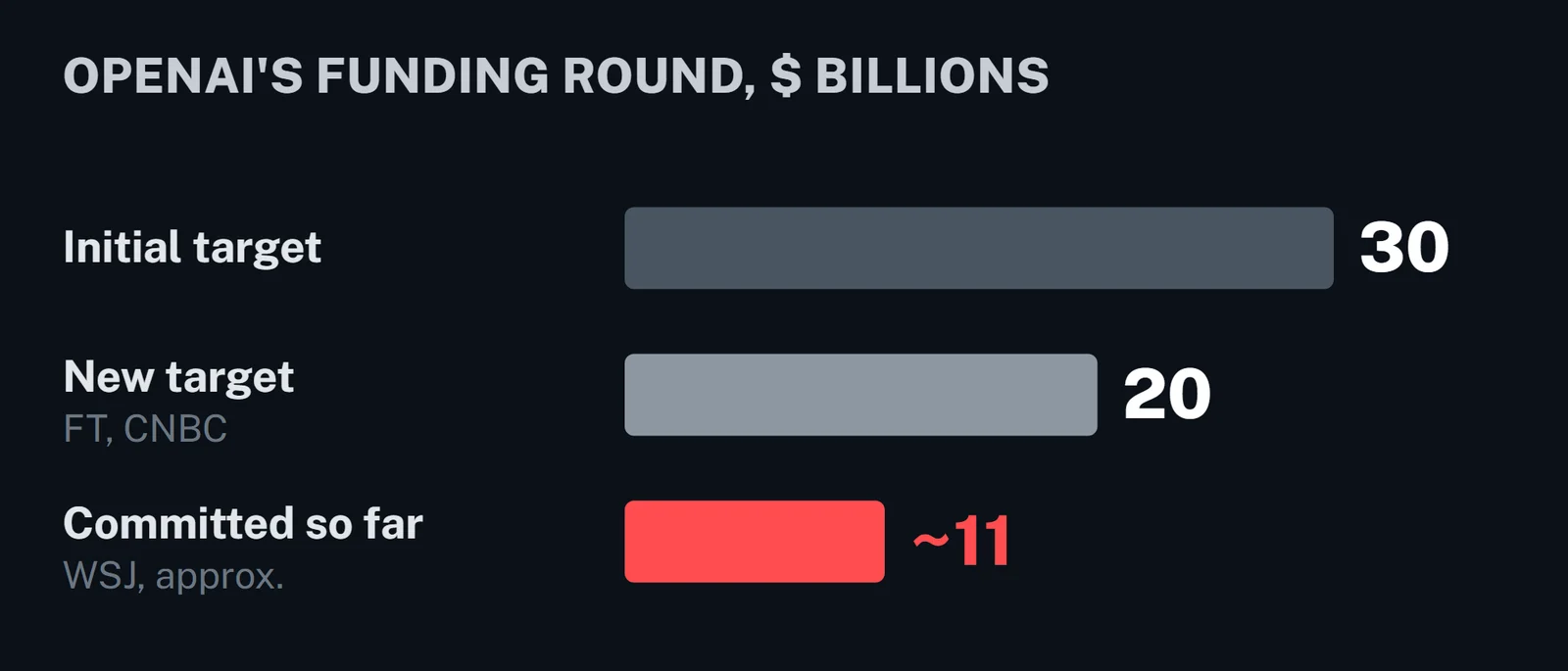
According to a Wall Street Journal report on October 30, OpenAI has secured about $11 billion in commitments so far in its new funding round, well short of its initial $30 billion target. The round values OpenAI at $1.25 trillion; the WSJ says the company initially sought a $1.4 trillion valuation. According to the report, some major investors stayed out amid concerns about the financial sustainability of AI spending, and OpenAI plans to approach family offices and wealthy individuals in the coming weeks.
The Financial Times reported the same day that OpenAI had cut its goal by $10 billion to $20 billion; CNBC confirmed this on October 31. According to the FT, OpenAI had set Friday, October 30, as the deadline for investors to commit, and some investors reduced their allocations. A source told CNBC that the round is still in progress and the figures are subject to change. OpenAI did not respond to CNBC’s request for comment.
CNBC first reported the round on October 22: OpenAI was nearing a funding round of up to $30 billion at a $1.25 trillion valuation, led by investors from the United Arab Emirates alongside Coatue. CNBC described it as an “opportunistic” bridge ahead of a potential IPO. That report gave $1.25 trillion as a pre-money valuation; the FT describes the same figure as post-money. In other words, with the smaller target, the valuation may have effectively come down as well. OpenAI’s previous round was in March 2026, when it raised $122 billion at an $852 billion valuation.
The WSJ report also shows the gap between OpenAI and Anthropic. According to the report, Anthropic more than doubled its quarterly revenue to $11.6 billion in the second quarter, while OpenAI’s revenue grew about 18% to $6.7 billion over the same period. Anthropic posted a small operating profit in the second quarter, while OpenAI’s operating losses widened. Third-party data cited by the WSJ show that OpenAI regained some market share after cutting prices on its latest models.
Four giants are spending $730 billion this year
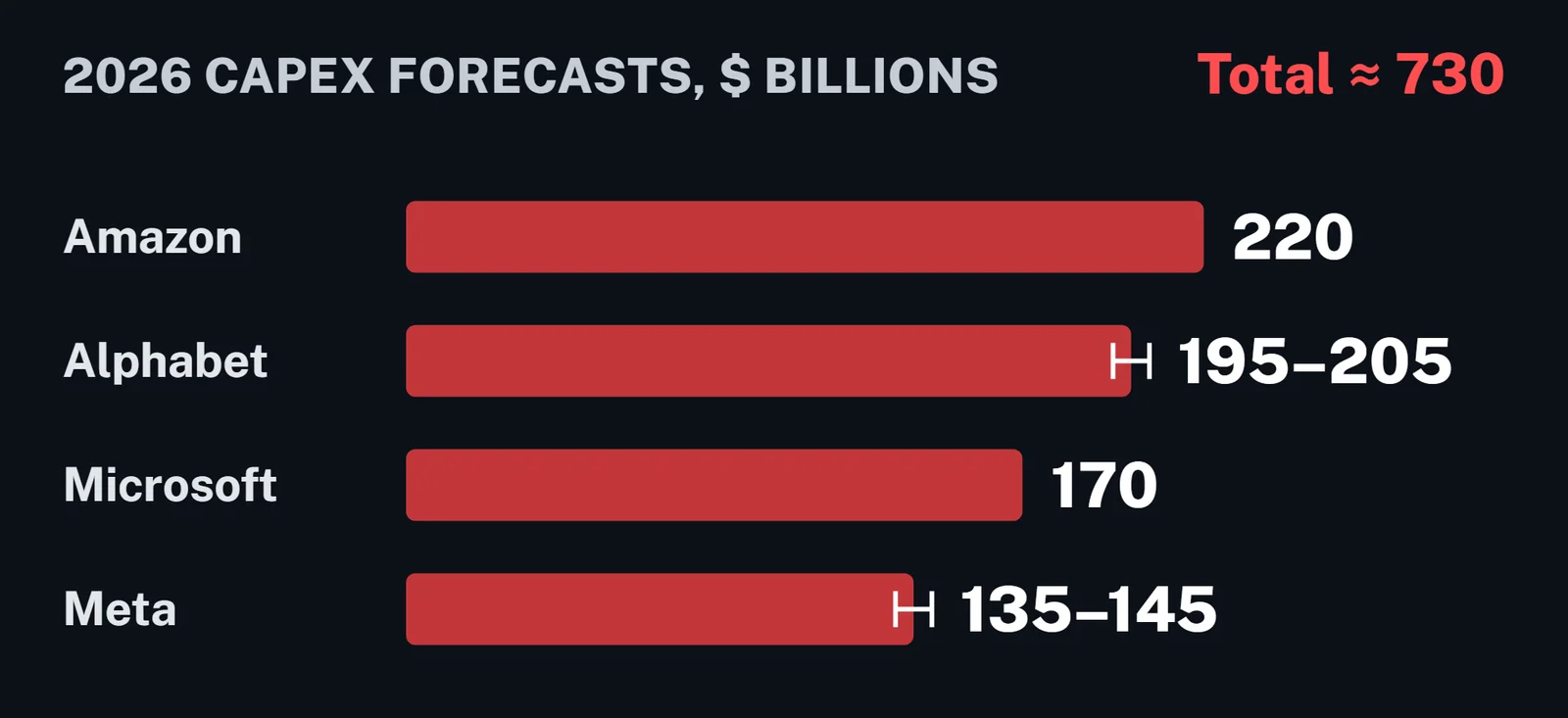
The 2026 capital spending forecasts of the four big cloud companies add up to about $730 billion: about $220 billion for Amazon, $195 billion to $205 billion for Alphabet, $170 billion for Microsoft and $135 billion to $145 billion for Meta. Using the midpoints of the ranges, the total is $730 billion; using the ends of the ranges, it is $720 billion to $740 billion. According to CNBC, Microsoft’s figure is for calendar 2026. Amazon alone spent $77.3 billion in the third quarter, up from $35.1 billion a year earlier. According to CNBC, the big cloud companies’ combined spending is expected to top $1 trillion next year.
Cash can’t keep up
The common theme of the week’s earnings was AI data center spending starting to outrun the cash the companies generate.
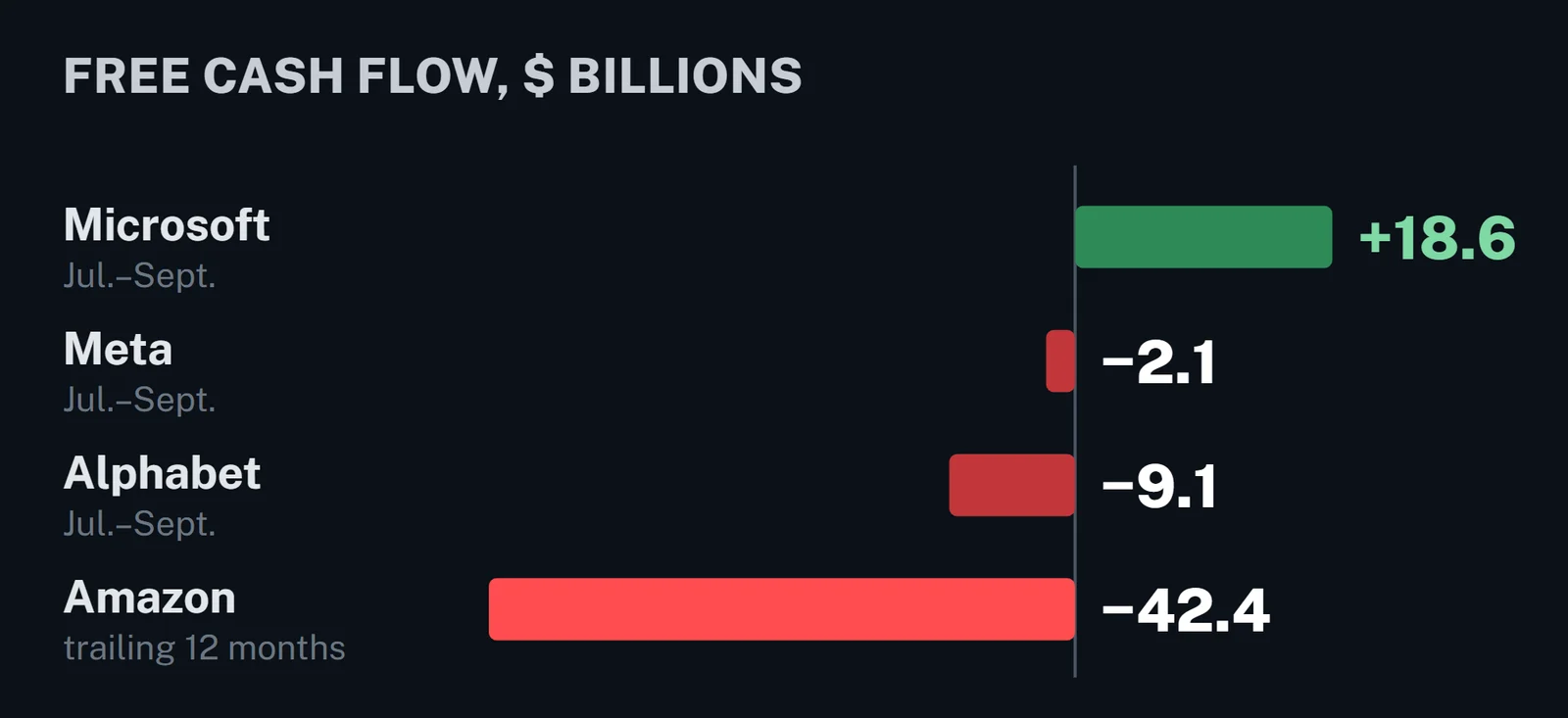
Amazon: According to its earnings release, free cash flow for the trailing twelve months was an outflow of $42.4 billion, compared with an inflow of $14.8 billion a year earlier. The release attributes the decline mainly to a $94.8 billion year-over-year increase in purchases of property and equipment. Operating cash flow rose 29% to $168.3 billion over the same period. Quarterly capital expenditures ($77.3 billion) were also above the $58.7 billion analysts expected. Amazon kept its 2026 capital spending forecast at $220 billion, and CEO Andy Jassy said the company expects to “spend meaningfully more in 2027.” AWS revenue grew 39% to $45.98 billion, but total revenue ($201.9 billion) and earnings per share ($1.89) missed estimates.
Meta: According to CNBC, Meta’s free cash flow was negative $2.12 billion in the third quarter. The company narrowed its 2026 capital spending forecast to $135 billion to $145 billion, raising the low end from $130 billion. Meta plans to raise $95 billion for AI: $35 billion through underwritten public equity offerings and $60 billion through an at-the-market program. On October 30, S&P Global Ratings kept Meta’s AA- rating but revised its outlook to negative from stable, saying it is unclear when Meta’s AI investments will generate material revenue. A Meta spokesperson said, “We respectfully disagree with S&P’s assertion about Meta’s AI monetization capabilities.” Meta’s stock ended October down 15%, its worst month in four years, according to CNBC.
Microsoft: Microsoft’s free cash flow stayed positive but fell 27% to $18.63 billion. Its capital expenditures and finance leases for the quarter were $45.2 billion, up 30% from a year earlier but below the $50.67 billion analysts expected. Microsoft cut its capital spending forecast for the year to $170 billion from $175 billion, a supply delay rather than a spending pullback. Finance chief Amy Hood said delays at third-party GPU providers “will push out some available capacity until the first half of 2027.” Microsoft’s stock was roughly flat on October 29. That evening the company announced plans to raise $25 billion in bonds; according to CNBC, the offering is expected to close on November 4, with the proceeds going to general corporate purposes. On the earnings call, Hood had said the company has access to the debt markets but hadn’t yet tapped them.
According to CNBC, the big cloud companies’ combined capital spending is expected to top $1 trillion next year. Daniel Newman, CEO of Futurum Group, summed it up for CNBC: “Everybody’s still full steam ahead on AI, but all the things around it took an interesting turn this week.” According to Newman, companies are realizing they can’t keep funding this spending out of free cash flow.
The selloff spread to chip and infrastructure stocks
The Nasdaq Composite fell 2.9% on October 30 to close at 25,437. According to CNBC, that gave the index its first three-week losing streak since March; it lost 5.3% in October. The S&P 500 fell 1.8% and the Philadelphia Semiconductor Index dropped 7.2% the same day.
Intel had the day’s steepest drop. The stock fell 28.6%, from $92.07 to $65.76, its worst day since the 1970s according to CNBC. Intel’s drop had more to do with its own guidance than with AI spending: the company forecast fourth-quarter revenue of $15 billion to $16 billion and adjusted earnings of 25 cents per share, while analysts expected $17.1 billion and 43 cents. Intel blamed a plant shutdown in Israel and weakness in the PC market. According to CNBC, an explosion at the Israeli fab is expected to cost about $600 million in lost revenue over two quarters. The drop wiped about $12 billion off the value of the US government’s roughly 10% stake in Intel. Before the report, the stock had risen about 150% this year.
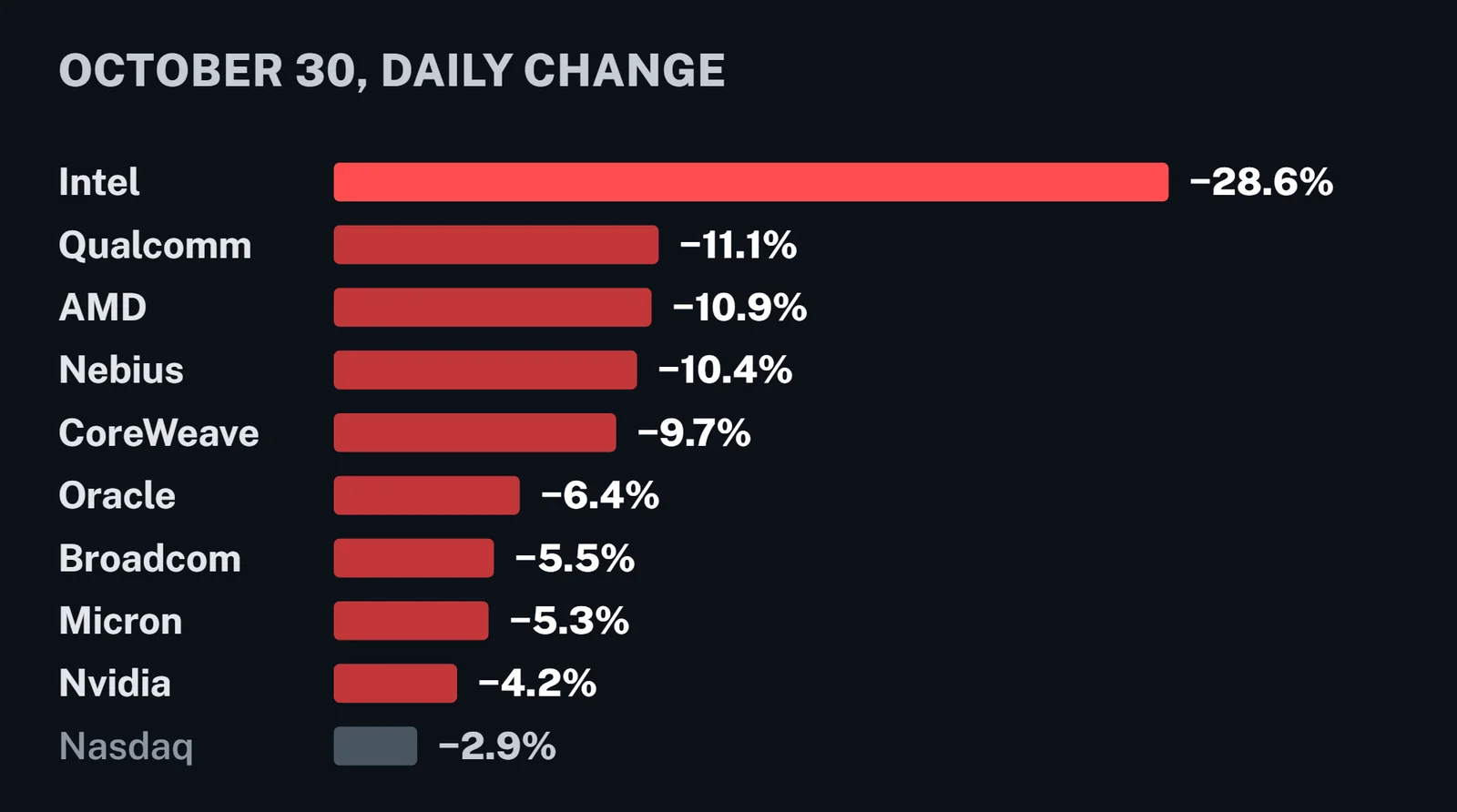
The selloff went beyond Intel: Qualcomm fell 11.1%, AMD 10.9%, Broadcom 5.5%, Micron 5.3% and Nvidia 4.2%. Nebius and CoreWeave, cloud providers that rent computing power to AI companies, fell 10.4% and 9.7%; over the whole of October, the two stocks lost 35% and 37%. Oracle fell 6.4%.
Next up: Anthropic’s IPO
According to a CNBC analysis on October 31, the week’s selloff has also made the road to the Nasdaq bumpier for Anthropic, which is pursuing a potentially record-setting IPO in the coming weeks. Anthropic gets much of its computing capacity from Amazon, Google and SpaceX, but also relies on newer cloud providers such as CoreWeave and Nebius. According to CNBC, the IPO market has largely been frozen since SpaceX’s record offering in June. “Anthropic is the IPO market at this point,” Daniel Newman said. He added that companies “would have to be extremely cautious, if not just foolish, to actually want to come out in this period.”
Sources
12 sources
- “OpenAI raises just $11bn of $30bn target as AI investor appetite cools - WSJ”Summary of the WSJ report: about $11 billion committed, $1.25 trillion and $1.4 trillion, OpenAI and Anthropic revenue · uk.investing.com
- “OpenAI pares fundraising goal, now seeking up to $20 billion in latest round”The goal cut to $20 billion (confirming the FT report), the deadline and the round still open · cnbc.com
- “OpenAI nears up to $30 billion funding round at $1.25 trillion valuation led by UAE investors”The round as first reported: up to $30 billion, UAE investors and Coatue, IPO plans · cnbc.com
- “Alphabet tanks nearly 13% for worst day ever, losing $500 billion in value”Alphabet’s record drop and cash flow; Microsoft’s cash flow and spending · cnbc.com
- “AI buildout hits snag as Google and Microsoft put off raising capex forecasts”Microsoft’s $170 billion forecast, Hood’s and Ashkenazi’s comments, the $1 trillion combined spending outlook · cnbc.com
- “Amazon.com Announces Third Quarter Results”Trailing twelve-month free cash flow, operating cash flow and revenue · ir.aboutamazon.com
- “Amazon posts negative free cash flow of $42.4 billion, holds 2026 capex unchanged”Quarterly capex, the $220 billion forecast, AWS and estimates · cnbc.com
- “Meta outlook revised downward by S&P on cash flow and capex concerns”S&P’s decision, Meta’s cash flow, spending and financing plans, Meta’s response · cnbc.com
- “Intel stock has worst day since 1970s, wiping about $12 billion off government’s stake”Intel’s drop, guidance and causes; the Nasdaq and other chip stocks · cnbc.com
- “Anthropic’s path to the Nasdaq just got a lot bumpier”The selloff’s effect on Anthropic’s IPO, the Nasdaq’s three-week losing streak, Daniel Newman’s comments · cnbc.com
- “Microsoft plans to raise $25 billion in debt as it pursues AI buildout”The $25 billion bond sale and the $170 billion 2026 capex target · cnbc.com
- Chart data: daily closes for stocks and indexes · finance.yahoo.com
About this story
- Written by
- Yiğit Kasap · JARRUS
- Story date
- On the site
- since Nov. 1, 2026
- Short link
thejarrus.com/en/ai-money-cooling- Report an error
- Spotted an error in this story? [email protected] · Instagram
Related
OpenAI is nearing a funding round of up to $30 billion at a $1.25 trillion valuation, sources say
Microsoft and Alphabet both grew their cloud businesses fast, but their stocks split
Anthropic files its IPO prospectus, detailing revenue, margins, compute commitments and founder control
FT: OpenAI projects $278 billion of negative cash flow between 2026 and 2030