Meta’s Muse agent can now voice chat with users through an avatar they design
Voice is US-only for now, and Muse doesn’t see the user. The same week, Meta launched Spaces and bought the coding startup Conductor.
Cover of the Instagram post.
Sources: Meta Newsroom, Meta AI Research, Conductor +19
Voice and an animated avatar for Muse
On Nov. 5 at 6:30 p.m. UTC, Meta announced it was adding voice and expressive avatars to Muse, its personal AI agent. Meta says the real-time conversations it previewed at Connect 2026 are now in Muse’s mobile, web and Mac apps. A conversation starts with a tap on the phone icon in the app’s top-right corner. No phone number is involved; it’s a voice session that starts inside the app.
The feature is launching in the U.S. only to start. Within minutes, Meta Chief AI Officer Alexandr Wang wrote on X that Muse voice was out for everyone in the U.S. The announcement doesn’t say whether a paid plan is required. Meta says voice conversations are coming soon to its AI glasses and the Muse Charm device, without giving a date. According to Meta’s research post, Muse is for users 18 and older.
The AI at Meta account wrote the same evening that Muse Realtime Avatar, previewed at Connect, was rolling out in the Muse app in the U.S. The account’s demo features a talking tin character named “Tinley.”
 AI at Meta@AIatMeta
During Connect, we previewed Muse Realtime Avatar, our real-time embodiment technology that turns Muse Realtime Voice into expressive, interactive avatars.
Today, we’re rolling it out in the @Muse app in the US, giving people a more natural way to engage with their personal agents.
Learn more about Muse Realtime Avatar on our research blog: go.meta.me/47ZSNso

Three views, hundreds of voices, a swappable avatar
Users choose how present Muse is: voice only, the avatar alongside the conversation, or full screen for a face-to-face feel. Meta says there are hundreds of voices to choose from. The company cites styles such as “New Yorker” and “pirate” and says the voice can be changed at any time. Users can also interrupt Muse.
Meta pitches voice mode not as a chatbot’s voice but as a way to talk to an agent that works while the conversation goes on. According to the announcement, a user can say what needs doing while on a walk or with full hands, and Muse handles it in the background. At Connect, Meta had written that talking to an agent as capable as Muse is different from voice chat with an assistant. The company said Muse keeps working in the background during long conversations.
The video side runs one way. According to TechCrunch, Muse doesn’t actually see the user; it hears them and reacts to the conversation. The avatar’s video streams to the user, and the user’s camera isn’t used.
TechCrunch says the avatar is nicknamed Jolly; it’s a cream-colored, furry figure. A “Jolly” label also appears under the default character in a Meta Spaces video from Nov. 6. The avatar can be changed into a person, an animal or another character, and Meta’s newsroom video shows Jolly in a cowboy hat. The Verge’s Jay Peters made an avatar resembling Zuckerberg and found the result a little uncanny. Peters said the agent responds quickly over voice but occasionally pauses while looking up information. The tone can be changed by asking the agent or in the avatar settings.
Under the hood: Muse Realtime Voice and Avatar
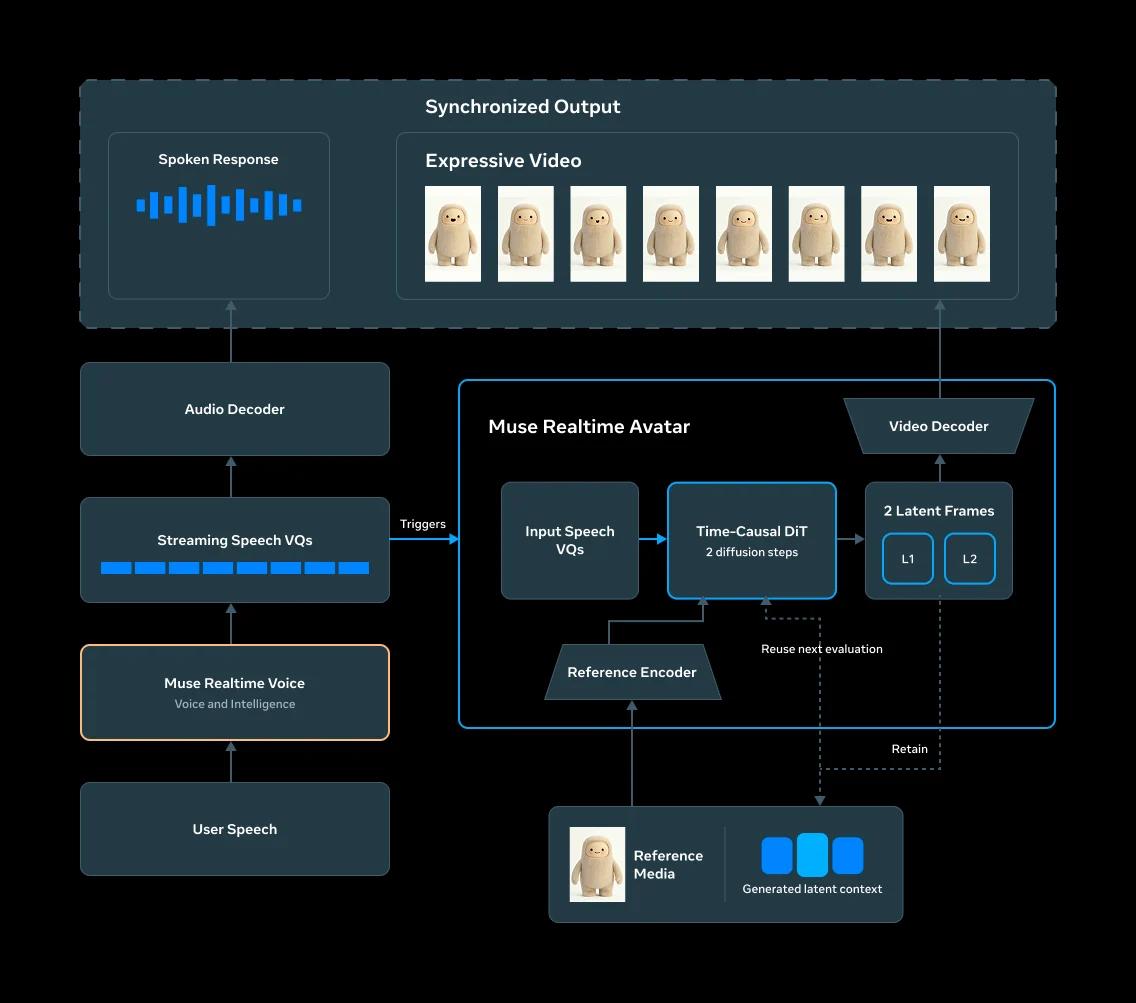
In a research post published Sept. 23, around Connect, Meta describes the system’s two parts. Muse Realtime Voice produces the conversational intelligence and speech tokens (VQ). Those tokens carry both what is said and how it is said. An audio decoder turns the stream into sound, while Muse Realtime Avatar turns the same stream into video. Meta says sharing one token stream keeps voice, lip motion and expression in sync.
The avatar model is an audio-driven Diffusion Transformer. It is conditioned on the speech-token stream, reference media and a rolling window of recent video latents. Video is generated in short causal chunks, and the last latents of each chunk give the next one its motion context. That keeps compute bounded while generation continues for as long as the conversation does. Meta calls it “real-time infinite video generation.”
To reach real time, Meta uses self-forcing to reduce drift, along with distribution matching distillation (DMD). The teacher model uses 40 steps with three-way classifier-free guidance (CFG), or 120 evaluations per chunk. The student uses two unguided evaluations, a 60x reduction. Serving relies on a persistent KV cache, cache-aware routing and latency-aware dynamic batching. Meta adds 4-bit quantization-aware training, fused kernels and NVIDIA CUDA Graphs, and optimized the stack together with NVIDIA.
By Meta’s measurements, the avatar streams 448x768 portrait video at 25 frames per second. The first byte of the synchronized voice-and-video response arrives about 870 milliseconds after the user stops talking. On a single NVIDIA GB200, one session’s 8 frames (320 milliseconds of playback) are generated in 20 milliseconds. One GB200 can run 12 concurrent sessions, 8 times the capacity of a two-step BF16 baseline. Meta Video Seal embeds a durable, invisible watermark in the avatar video. These figures come from the September research post; Meta hasn’t published current numbers for the app. The post also notes that not all of its examples reflect avatars available in the Muse app.
Meta’s own comparison
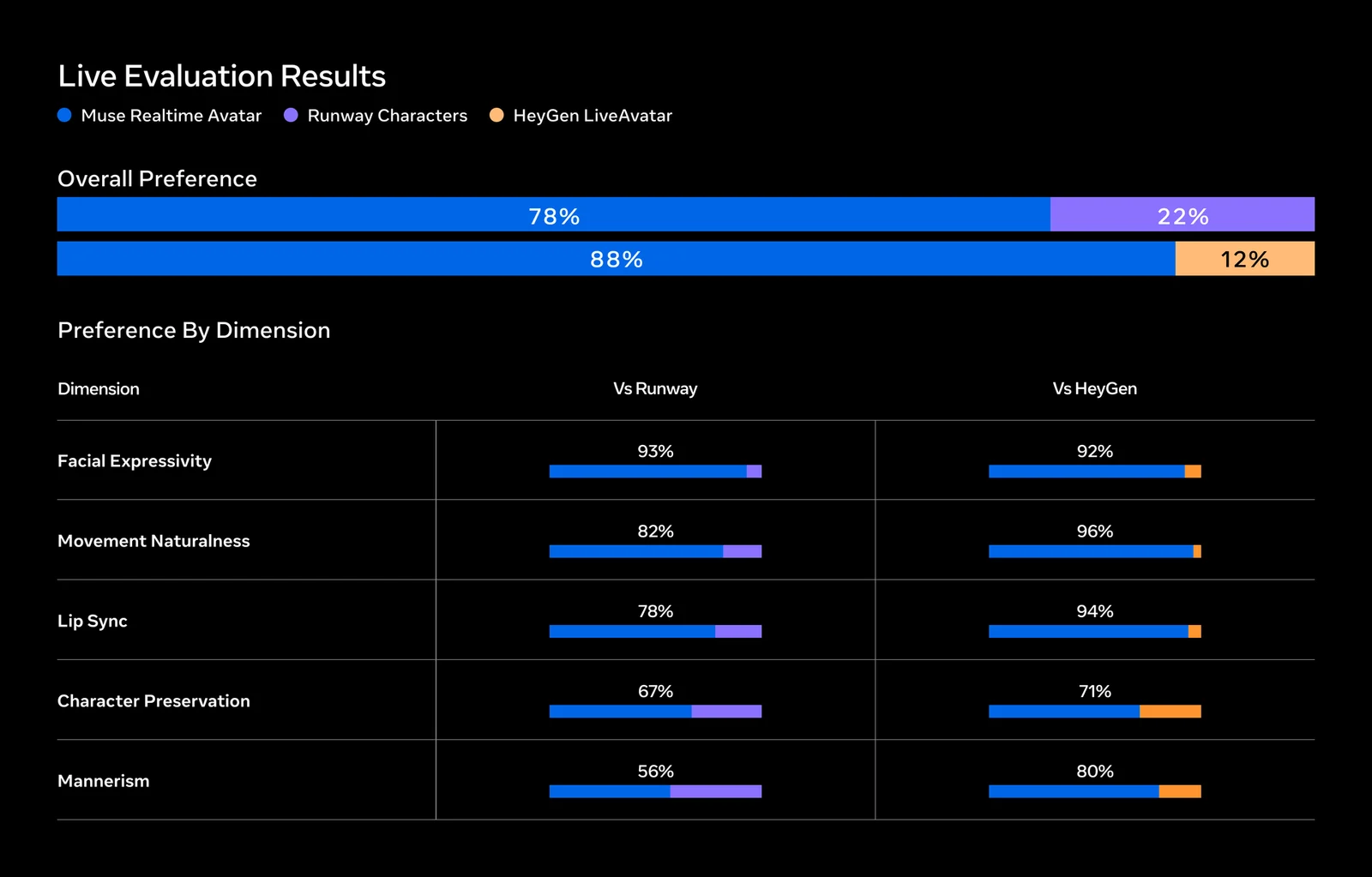
In the same post, Meta compared Muse Realtime Avatar with two commercial live-avatar products. Raters held live conversations lasting two to three minutes. In overall preference, Muse led Runway Characters 78% to 22% and HeyGen LiveAvatar 88% to 12%. Meta says the 56% result against Runway on mannerism isn’t statistically significant. The comparison is Meta’s own test, not an independent evaluation.
In rival voice modes, video flows the other way. According to OpenAI’s Help Center, ChatGPT Voice’s “Live” option runs on GPT-Live-1.1 and can listen and talk at the same time. It can also use web search, memory and connected apps. Live doesn’t support video or screen sharing, while the older “Advanced” voice experience supports both on mobile. Google’s Gemini Live can also use the camera during a live voice chat and connect to Google apps. In those products, video goes from the user to the model; in Muse, it flows from the avatar to the user. TechCrunch lists OpenAI’s dots and Musk’s Grok Bot as rivals with cute characters.
Spaces: Muse builds its own screens in the app
Meta announced Spaces on Nov. 6 at 6 p.m. UTC; the company writes the name in lowercase. Meta describes a space as a custom experience a user creates inside Muse by describing an idea. Examples include a holiday gift tracker, a daily word game and a planning board for a DIY project. The user describes the idea and Muse builds the space, which can be changed later by telling Muse.
Spaces can be pinned to the sidebar or main tabs, hidden, or scheduled to appear at certain times. In Meta’s example, a weekly planner sits up front during the workweek and gives way to weekend plans on Saturday. Meta says connected apps keep spaces up to date in the background. New concert dates, price changes or savings progress show up without anyone having to ask. According to The Verge, apps that can be connected include Gmail, Google Calendar, OpenTable and Notion.
Meta’s list of examples includes a shopping mall that gathers Instagram saves and Marketplace listings. It also includes a school dashboard that adds events from school emails to the calendar. A music tracker, a wedding planner, a trivia game, a podcast studio, a small-business order tracker, a freelancer client hub and a trip planner round out the list. Spaces are available everywhere Muse is: the U.S., Canada, Singapore and Mexico. Meta says sharing spaces with others is something it’s “exploring.”
Zuckerberg posted on X the same day about building a BBQ game, an event tracker and a home control dashboard with Spaces. The examples suggest spaces can be interactive mini-apps, not just lists.
 Mark Zuckerberg@finkd
Playing around with spaces in Muse lately -- tell Muse what you need and it builds it.
I've made a BBQ game, an event tracker, and a home control dashboard.
Excited to see what you build.


Meta buys Conductor
Axios reported on Nov. 4 at 6:15 p.m. UTC that Meta had acquired AI coding startup Conductor. Terms weren’t disclosed. CEO Charlie Holtz and CTO Jackson de Campos founded the company in 2024. According to TechCrunch, Meta confirmed the deal but gave no further details.
Conductor doesn’t build its own coding agent. According to its homepage, it runs the first-party Claude Code, Codex, Cursor and OpenCode agents under the hood. Each agent gets its own isolated copy of the codebase, and developers review and merge the agents’ work. Conductor Cloud ran the agents in Firecracker microVMs. The first version came out in July 2025. On March 30, 2026, Conductor announced a $22 million Series A from Spark and Matrix. Y Combinator and the founders of Notion and Linear also took part. At the time, Conductor said its user base had grown 10x since January.
Holtz wrote on X the same day that Conductor was joining Meta and had “big, crazy plans for the next interface.” According to Holtz, the team will work with Nat Friedman and Alexandr Wang at Meta Superintelligence Labs (MSL). Wang welcomed the team in a post the next day. There has been no statement that the team joined Muse Code, Meta’s coding agent.
Conductor’s announcement lays out a timeline. New signups and downloads closed on Nov. 4. Free users can no longer upgrade to Pro, while Pro users keep Pro features for free. Conductor Cloud goes read-only on Nov. 13, with refunds for active subscribers. The cloud service shuts down on Nov. 20, when deletion of cloud user data begins. The local Conductor app will get new models and critical bug fixes until early 2027. All user data will be deleted when the app shuts down. The company says it has never sold or trained on user data and still won’t. According to Conductor, a new product will be available early next year.
Meta launched its own coding agent, Muse Code, in August, and the Muse Wonder Full model is available only on Muse Code plans. Axios says the deal puts Meta in the race over coding tools. OpenAI announced plans to acquire Pierre Computer the same day. Conductor hasn’t said what its new product will be.
 Charlie Holtz@charlieholtz
I am very excited to share that Conductor is joining Meta!
We have some big, crazy plans for the next interface. If you liked Conductor, you’re gonna love what’s coming.
We’re super excited to work with @natfriedman and @alexandr_wang at MSL to build it. They’ve been on an absolute tear, and I’m convinced MSL has the highest talent density of all the labs.
A huge thank you to our earliest believers @aaron_epstein, @ilyasu, and @nabeel. And to everyone here who tried Conductor, sent us feedback, and prompt requests - you made this so much fun. Thank you ❤️🚂
Choo choo!

Same week: new models, Mexico and Muse Charm
On Nov. 6, Muse and Meta AI switched to specialized models trained using Muse Wonder. Meta says the models carry Muse Wonder’s Active Memory and Active Focus. They recognize when earlier information matters and find alternatives when constraints change. By the company’s own measurements, forgetting critical information in Muse fell 2.4x. Getting unstuck as constraints evolve improved by 67%. On Meta’s internal Personal Superintelligence Index, the new models scored 47%, up from 38%. On an Active Memory evaluation, the score rose from 76% to 90%.
AI at Meta@AIatMetaToday we're bringing specialized models trained using Muse Wonder to @Muse and Meta AI, giving users access to some of Muse Wonder's frontier capabilities for complex tasks at work and in everyday life.
These specialized models include Muse Wonder's Active Memory and Active Focus, helping them stay aligned with your goals as tasks unfold:
→ Active Memory helps recognize when earlier information matters and distinguish what's still relevant from what's become stale
→ Active Focus helps recover from setbacks or find alternatives when constraints change
In Muse, the improved models show a 2.4x reduction in forgetting information critical to your goals and a 67% improvement in getting unstuck as constraints evolve. That means less repeating yourself and fewer dead ends when plans change.
In Meta AI, these improvements help it break complex problems into steps, ask sharper follow-up questions and adapt when you change direction.
Read more on our research blog: go.meta.me/4kCPcHW

Muse launched in the U.S. on iOS, Android and the web on Sept. 8, followed by a Mac app. The agent reached Canada on Sept. 18 and, according to Meta, Singapore on Oct. 28. According to Muse’s X account, it launched in Mexico on Nov. 5; Meta’s English-language newsroom has no post about it.
Muse Charm, introduced at Connect, is a keychain-sized device with a small screen that shows the avatar. According to TechCrunch, users can talk to Muse by touching the device’s fingerprint sensor, without unlocking their phones. Zuckerberg said the whole Muse experience, including the real-time voice and avatar stack, had been packed into something that fits on a keychain. At Connect, Zuckerberg said the device would be ready to ship in time for the holidays in December. The Nov. 5 announcement only says “coming soon,” and no price has been announced.
Cover image generated with AI.
Sources
24 sources
- “Give Your Muse a Voice”Official announcement: voice and expressive avatars in the US on mobile, web and Mac; started from the phone icon; ‘coming soon’ to glasses and Muse Charm · about.fb.com
- “Design the Muse App, Just for You”Spaces announcement: custom spaces built from a description and updated in the background; available everywhere Muse is · about.fb.com
- “Bringing Your Muse to Life”Muse Realtime Avatar technical post: 448x768 at 25 fps, ~870 ms latency, 12 sessions per GB200; in-house comparison with Runway and HeyGen; 18+ age limit · research.meta.ai
- “Bringing Specialized Models to Muse and Meta AI”Specialized models trained using Muse Wonder; per Meta, a 2.4x reduction in forgetting and a 67% improvement in completing tasks · research.meta.ai
- “Conductor is joining Meta”Conductor’s announcement and timeline: Cloud goes read-only Nov. 13 and shuts down Nov. 20; the desktop app runs until early 2027 · conductor.build
- “Meta says US users can now video chat with their Muse AI avatar”The avatar is nicknamed Jolly and can be changed; Muse doesn’t see the user, it only hears them · techcrunch.com
- “Muse has a voice mode now”Hands-on: quick responses with occasional pauses; voice tone changes via settings or by asking the agent · theverge.com
- “Exclusive: Meta acquires AI coding startup Conductor”First report: founders Charlie Holtz (CEO) and Jackson de Campos (CTO); terms not disclosed · axios.com
- “Meta acquires AI coding startup Conductor”Meta confirmed the deal but gave no details; Conductor Cloud shuts down on Nov. 20 · techcrunch.com
- “The Biggest News From Connect 2026”Connect recap: voice described as long conversations with an agent that works in the background; more on Muse Charm promised ‘later this year’ · about.fb.com
- “Meta made a Tamagotchi-like wearable for its Muse AI agent”Muse Charm: keychain size, talking via the fingerprint sensor, Zuckerberg’s December holiday timing; the avatar known internally as Jolly · techcrunch.com
- “Meta introduces Spaces, a new way to collaborate with your Muse agent”Spaces report; OpenAI’s dots and Grok Bot named as rivals with cute characters · techcrunch.com
- “Meta’s Muse AI can create custom ‘spaces’ for the version of the app you need right now”Apps that can be connected to spaces: Gmail, Google Calendar, OpenTable, Notion · theverge.com
- “Conductor’s Series A”$22 million Series A from Spark and Matrix; Y Combinator and Notion and Linear founders; 10x user growth since January (per the company) · conductor.build
- “Conductor - Run a team of coding agents in the cloud”Product page: runs Claude Code, Codex, Cursor and OpenCode agents under the hood, isolated codebase copies, Firecracker microVMsconductor.build
- Muse launches in Mexico · x.com
- “Muse Is Now Available in Singapore: The World’s First Personal AI Agent Built for Everyone”Muse launches in Singapore · about.fb.com
- “ChatGPT Voice”Comparison: ChatGPT Voice’s Live option runs on GPT-Live-1.1 and listens and talks at once; no video or screen sharing in Livehelp.openai.com
- “Gemini Live: Yapay zekaya dilediğiniz modda soru sorun”Comparison: Gemini Live can use the camera during live voice chats and connect to Google appsgemini.google
About this story
- Written by
- Yiğit Kasap · JARRUS
- Story date
- On the site
- since Nov. 8, 2026
- Short link
thejarrus.com/en/meta-muse-voice- Report an error
- Spotted an error in this story? [email protected] · Instagram