GoogleModelsPricing and access
Google rolls out Gemini 4 Neon to paying users
Adapted from Carbon, Neon costs $3/$15; it leads most rows of Google’s table, and Artificial Analysis finds it strong but slow.
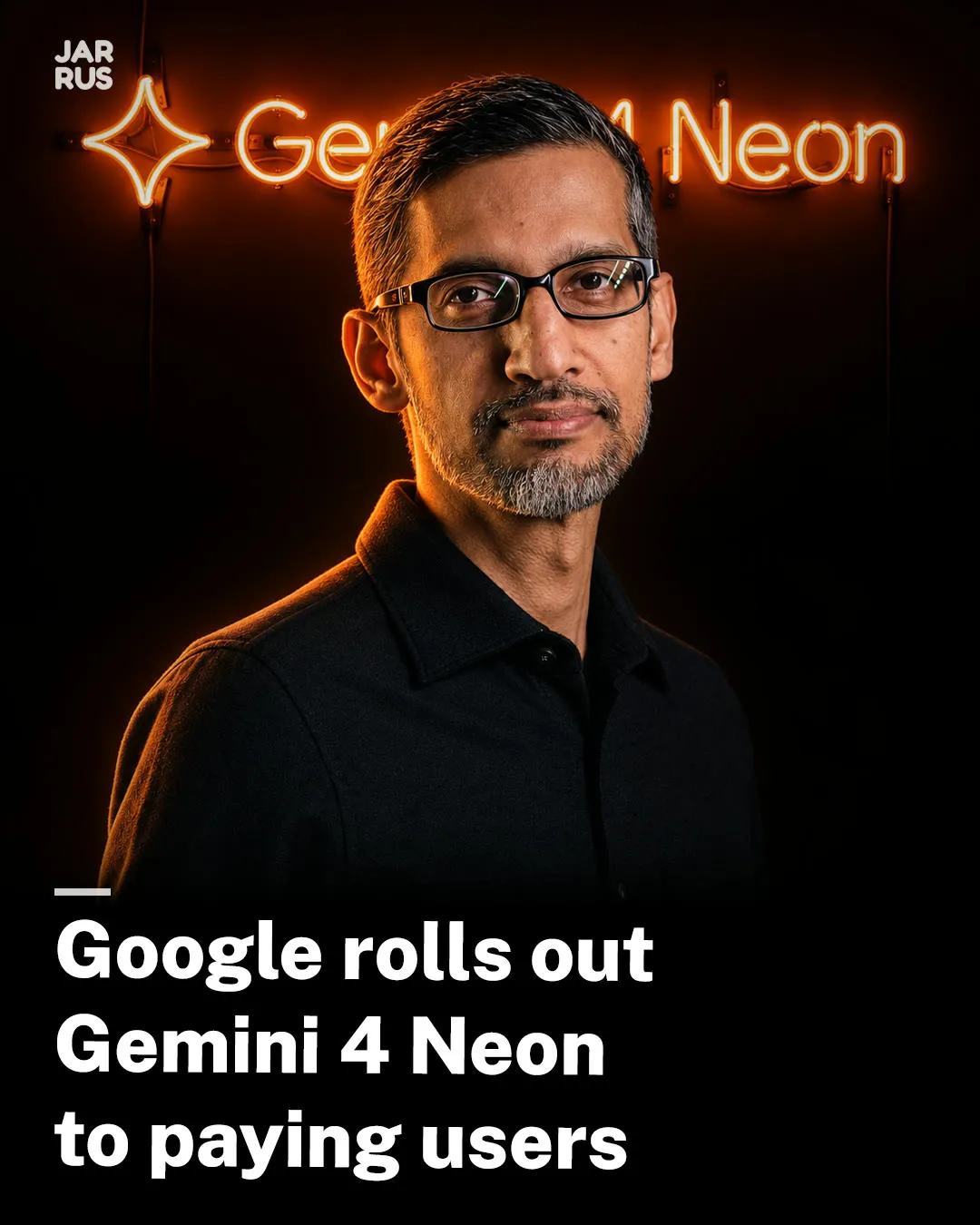
Cover of the Instagram post.
Sources: Google, Google DeepMind, Google AI Studio +6
Neon joins the Gemini 4 family
Google introduced Gemini 4 Neon on Nov. 18. The model is adapted from Gemini 4 Carbon, the company’s most powerful model.
Google says Carbon is for the hardest, longest projects and Hydrogen for fast everyday work, while Neon balances depth and efficiency.
$3 and $15
Neon’s API price is $3 per million input tokens and $15 per million output tokens; Carbon costs $4 and $20. It has a 1 million token context window and four thinking levels.
It’s available to Google AI Pro and Ultra subscribers in the Gemini app and Antigravity. It isn’t on the API’s free tier.
Ahead on most rows of Google’s table
In Google’s own comparison, Neon leads Claude Opus 5.5 and GPT-6.2 Sol on 16 of 19 rows.
Opus 5.5 is ahead on Terminal-bench 4.1 and FrontierCode 2.0, and GPT-6.2 Sol on Chartography. The numbers are Google’s own measurements.
Independent test: strong but slow
On launch day, Artificial Analysis ranked Neon third on its Intelligence Index with 61, behind GPT-6.2 Astra and Claude Fable 5.2. At its highest setting, its cost per task is about 17% lower than Carbon’s.
But it’s slow: it takes about 22 minutes per task on average. The firm calls it notably slow and very verbose. On Nov. 22, Artificial Analysis’s model page listed Neon 6th of 95 models; the page doesn’t explain the difference from its launch-day third place.
A ski simulator from scratch
Google says Neon wrote a first-person ski simulator from scratch in Antigravity, the company’s coding tool, on real Mont Blanc and Chamonix terrain data.
It combines 10,200 lines of custom shaders, ski physics running at 120 Hz and slab avalanches, with zero pre-made assets.
Turing’s study, 1936
Google says Neon used /swarm, its agent swarm feature, to pull archival photos and rebuild Alan Turing’s 1936 study at King’s College in interactive 3D. A working Universal Turing Machine runs on the desk.
Sources
9 sources
- “Introducing Gemini 4 Neon”Google’s launch post: positioning, pricing, benchmarks, availability. · blog.google
- “Gemini 4 Neon -- Model Card”Model card: adapted from Carbon, 1M context, March 2026 knowledge cutoff. · storage.googleapis.com
- Model codes and limits for Neon, Argon, Carbon, Hydrogen (read date). · aistudio.google.com
- “Google continues to accelerate its release cadence with Gemini 4 Neon”AA: score 61, 3rd overall at launch, cost and speed measurements. · artificialanalysis.ai
- “Gemini 4 Neon: Intelligence, Performance & Price Analysis”AA model page: effort levels, 106 tok/s, 22.3 min per task; shows #6/95 on 22 Nov. · artificialanalysis.ai
- “Gemini 4 Neon: I tested it against Opus 5.5”Independent developer test: time, token and cost comparison. · flaviocopes.com
- “Gemini 4 Neon”Secondary: Gemini app model picker and replacing Argon (cross-check only). · 9to5google.com
About this story
- Written by
- Yiğit Kasap · JARRUS
- Story date
- On the site
- since Nov. 22, 2026
- Short link
thejarrus.com/en/gemini-4-neon- Report an error
- Spotted an error in this story? [email protected] · Instagram