GoogleModelsSafety and security
Google unveils Gemini 4 Carbon, its most powerful model
Gemini 4 Carbon ranks first on the Artificial Analysis index with 59 points. It focuses on cybersecurity and is opening first to selected cyber defenders.
Cover of the Instagram post.
Sources: Google, Google AI, Artificial Analysis +2
Google’s new most powerful model
Google unveiled Gemini 4 Carbon on Oct. 28. The announcement was written by Koray Kavukcuoglu, SVP at Google DeepMind and Google’s Chief AI Architect. Google calls Carbon its strongest model and highlights two areas: cybersecurity and long-horizon work. It follows Gemini 4 Argon, which Google opened to developers and paid users two weeks earlier.
 Google AI@GoogleAI
Announcing Gemini 4 Carbon, our strongest model with state-of-the-art cybersecurity and long horizon capabilities.
Carbon represents a step up across most benchmarks, delivering strong frontier performance in autonomous coding and cyber defense.
We’re first making Carbon available to a subset of trusted cyber defenders in our Fairwind program. We’ll expand access as soon as possible.

First in independent rankings
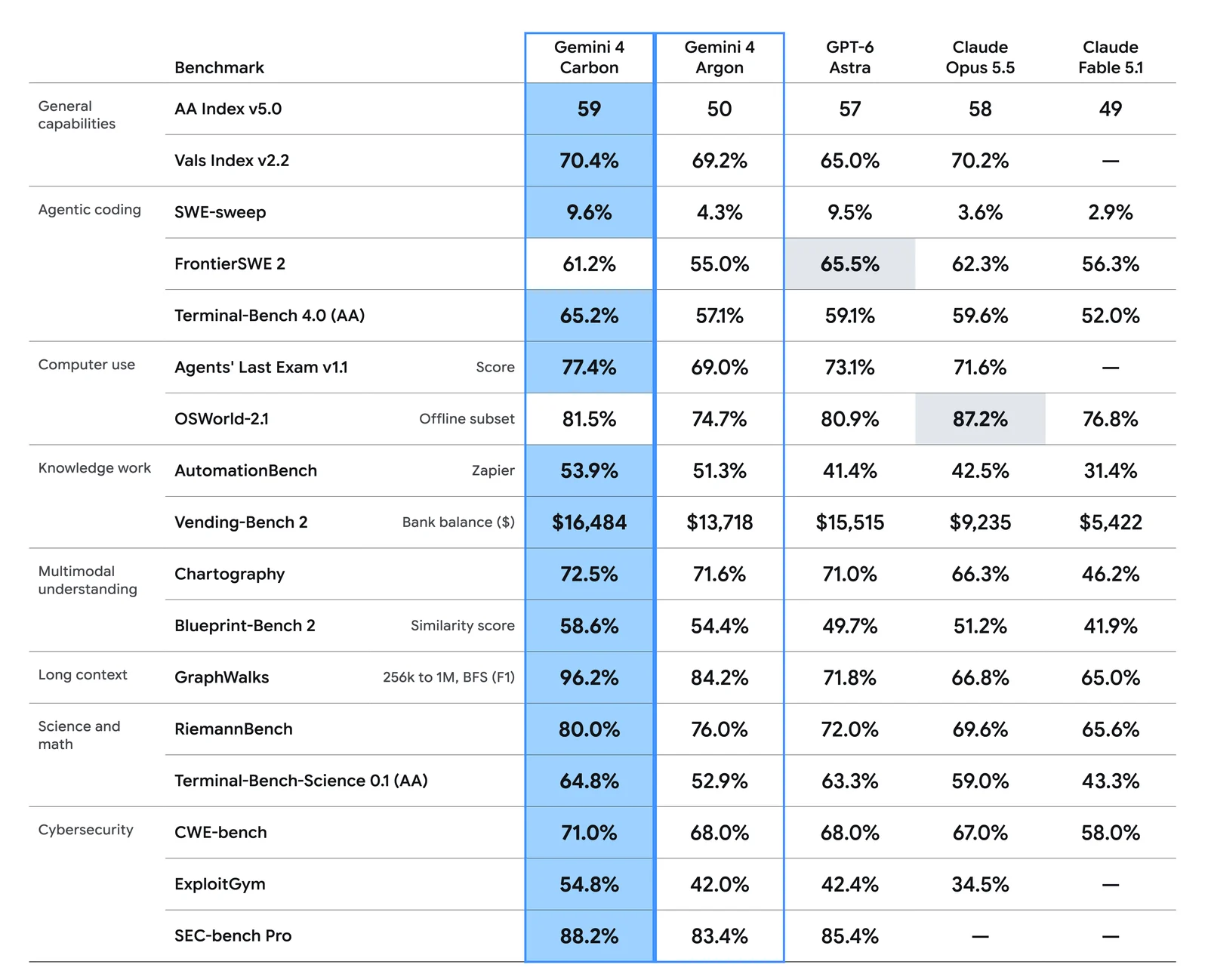
On Artificial Analysis’ Intelligence Index v5.0, Carbon ranks first of 52 models with 59 points. According to Google’s table, Claude Opus 5.5 scores 58 on the same index, GPT-6 Astra 57 and Gemini 4 Argon 50. The index combines reasoning, coding, agentic and knowledge tests into a single score.
Artificial Analysis puts Carbon’s cost at $7.76 per index task. The model generated 200 million tokens while running the index, against a median of 64 million. Its context window is 1 million tokens. OfficeChai, citing Artificial Analysis data, reports a cost of $10.04 per task for Claude Opus 5.5. The same report puts Carbon’s hallucination rate on knowledge tests at 11%, against 50% for both Opus 5.5 and GPT-6 Astra.
On Vals AI’s Vals Index v2.2, Carbon scores 70.4%, just ahead of Opus 5.5 at 70.2%. On WebDev Arena, which compares models on web development tasks, its score rose 89 points to 1768, placing it fourth.
Not ahead on every test
Google’s table also shows where Carbon trails. On the FrontierSWE 2 coding test, GPT-6 Astra scores 65.5% to Carbon’s 61.2%. On the offline subset of OSWorld-2.1, which measures computer use, Claude Opus 5.5 scores 87.2% to Carbon’s 81.5%.
Carbon’s leads cover a wide range. It scores 65.2% on Terminal-Bench 4.0, which measures terminal tasks (Opus 5.5: 59.6%), and 77.4% on Agents’ Last Exam v1.1. On GraphWalks, a long-context test spanning 256,000 to 1 million tokens, it scores 96.2%, far ahead of Argon’s 84.2% and its rivals. On Vending-Bench 2, where it runs a simulated vending machine business, it ended with $16,484, against $15,515 for GPT-6 Astra and $9,235 for Opus 5.5.
A wide lead in cybersecurity
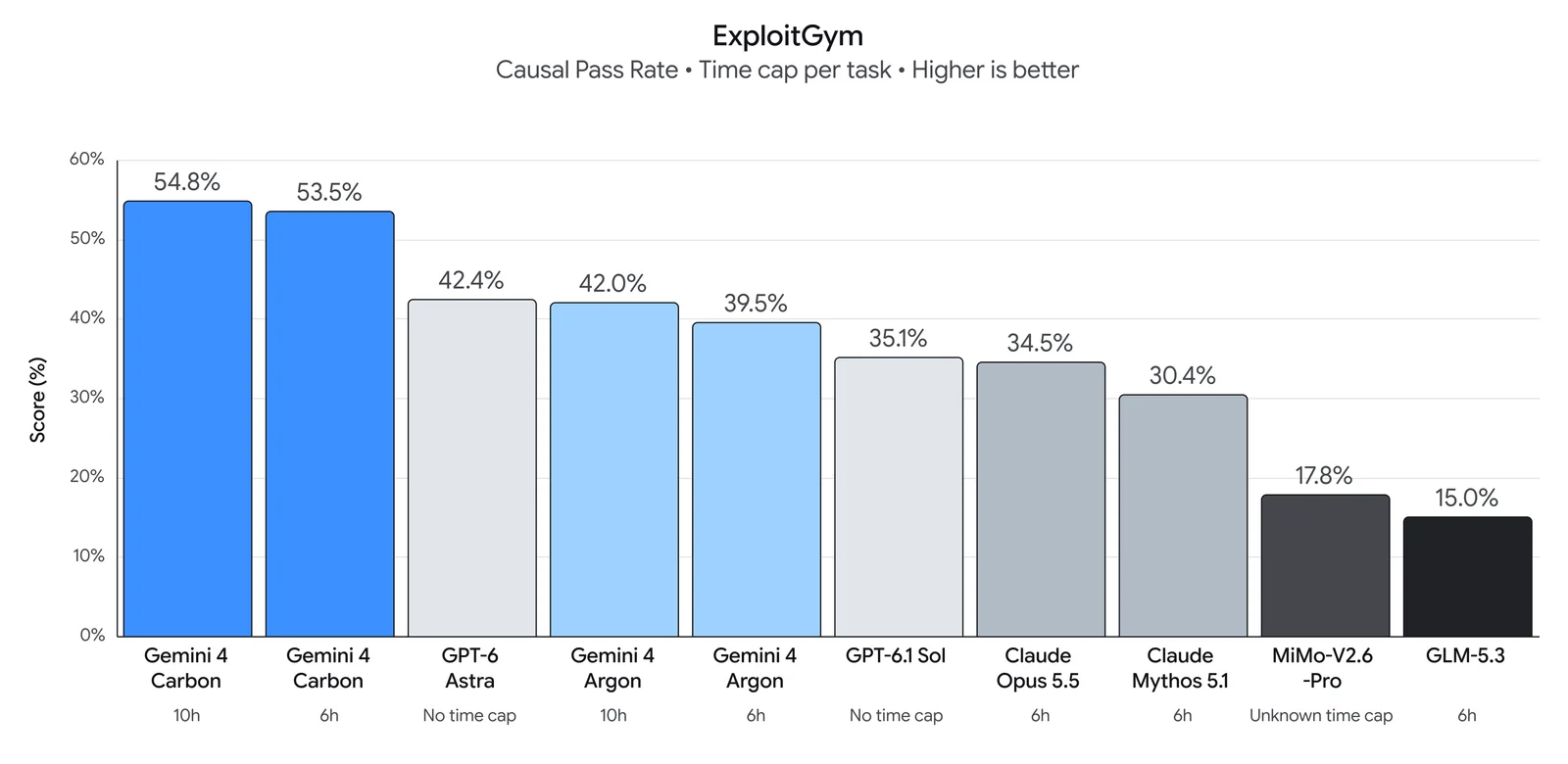
Google says it measured Carbon’s cybersecurity results with safety guardrails turned off. On SEC-bench Pro, a test of finding software vulnerabilities, Carbon set the top score at 88.2%, ahead of GPT-6 Astra at 85.4% and Argon at 83.4%. On ExploitGym, which measures exploiting vulnerabilities, it reached 54.8% with a 10-hour time cap per task and 53.5% with a 6-hour cap. Under the same 6-hour cap, Claude Opus 5.5 scored 34.5%; GPT-6 Astra, running without a time cap, scored 42.4%. On CWE-bench, which measures patching, Carbon leads at 71.0%, with Argon, GPT-6 Astra and Grok 4.7 at 68.0%.
Google’s internal benchmarks show Carbon more than doubling Argon’s success rate at generating secure code. The Chrome team reported that Carbon was more than 10 times better at generating high-quality patches than another lab’s large frontier model; Google did not name the rival model. Cloud security company Wiz also saw Carbon leading on web penetration testing benchmarks.
Work that runs for days
Google says teams inside the company have seen Carbon run for days on multi-step engineering tasks, pushing through dead ends. Its examples include root-causing and patching subtle bugs across large codebases and low-level systems.
Safety improvements
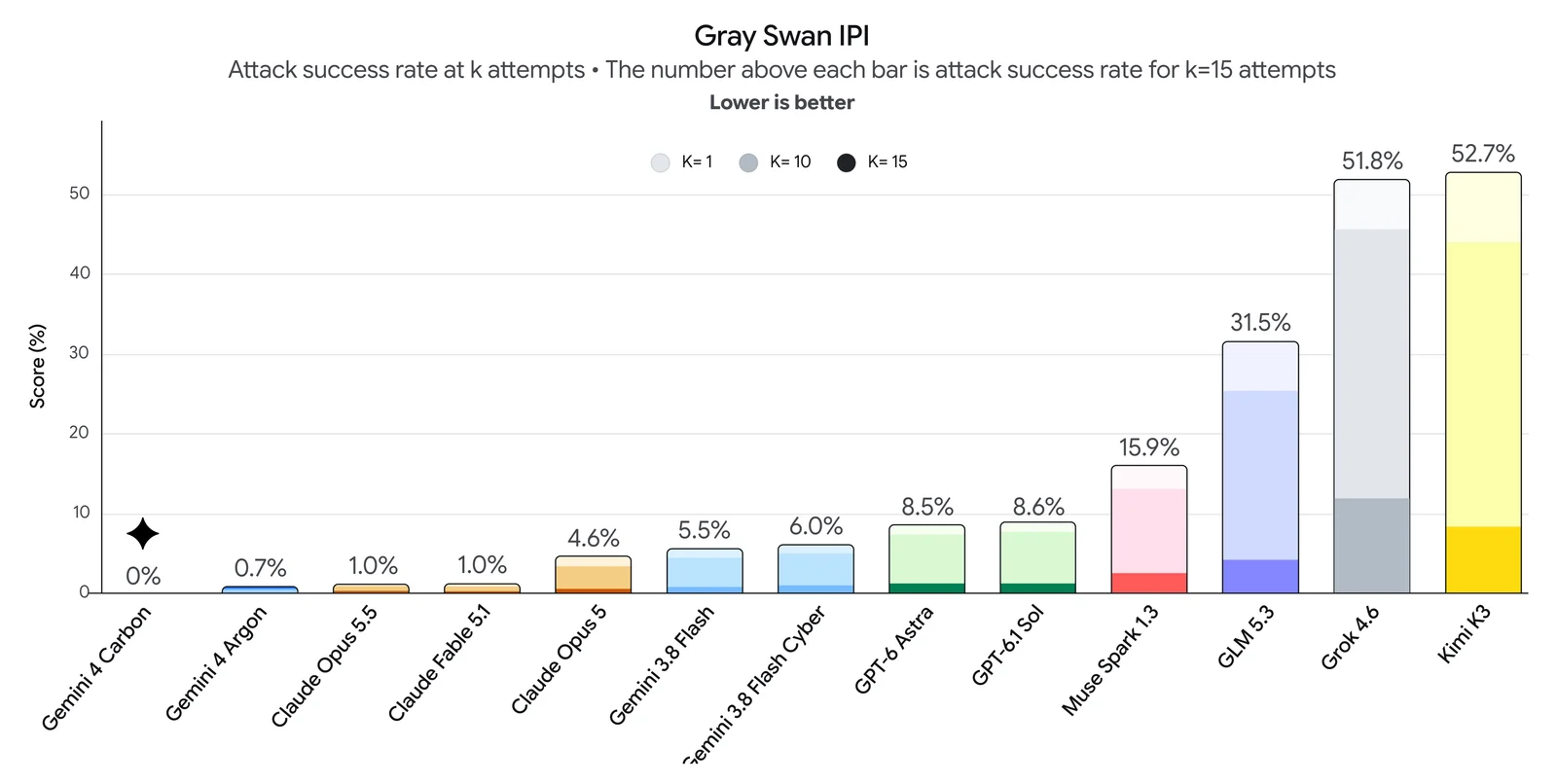
Carbon is built on the same layered safety stack as Argon: model training, real-time misuse defenses, resilience against prompt injection and chain-of-thought monitoring. On Gray Swan’s indirect prompt injection benchmark, attacks against Carbon succeeded 0.0% of the time. On the same test, attacks succeeded 0.7% of the time against Argon, 1.0% against Claude Opus 5.5 and 8.5% against GPT-6 Astra.
On Terminal-Bench 4.0, successful cheating fell to 0.0% and attempts to cheat to 0.4%. In Google’s live internal coding environments, high-severity misalignment alerts dropped by almost 80%. Compared with Argon, unsupported claims were cut roughly in half, overreach fell by 26% and under-service by 29%. Google published the details in its Gemini 4 safety report.
Price and access
Carbon launches at the same introductory price as Argon: $2 per million input tokens and $10 per million output tokens. Cached input tokens are 95% off. After the introductory period, the price will be $4 per million input tokens and $20 per million output tokens.
Starting this week, the model is available only to a subset of cyber defenders. Access will expand gradually to other trusted partners through Google’s Fairwind Program. Google said it is also taking part in the US government’s voluntary pre-release model testing process. There is no date yet for developers, businesses and consumers; Google says only that it will come “as soon as possible.”
Sources
5 sources
- “Gemini 4 Carbon: our next frontier model”Official announcement: benchmark results and comparison table, cybersecurity and safety evaluations, pricing and access · blog.google
- “Gemini 4 Carbon (High)”Independent evaluation: Intelligence Index 59, first of 52 models, cost per task, token use, context window · artificialanalysis.ai
- “Gemini 4 Carbon Beats Claude Opus 5.5 On Intelligence While Being 23% Cheaper”Comparison with Claude Opus 5.5 using Artificial Analysis data: cost per task and hallucination rate · officechai.com
About this story
- Written by
- Yiğit Kasap · JARRUS
- Story date
- On the site
- since Oct. 28, 2026
- Short link
thejarrus.com/en/gemini-4-carbon- Report an error
- Spotted an error in this story? [email protected] · Instagram