DeepSeek showcases Creator Mode in Harness, where the agent writes and installs plugins described in chat
Creator Mode has been an experiment since September. The Nov. 2 video shows a 3D Transformer lab, a voxel game and a theme plugin that restyles the app.

Cover of the Instagram post.
Sources: DeepSeek Harness, DeepSeek, GitHub +13
Creator Mode: building plugins through chat
On Nov. 2, DeepSeek’s Harness account posted a 99-second showcase video for Creator Mode. According to the announcement, the mode turns ideas into plugins people can use, from a design workspace to a sandbox game or a 3D LLM visualizer. Fourteen seconds later, the account shared a page with the English and Chinese prompts for the plugins in the video. As of Nov. 7, the post had more than 2.4 million views.
Creator Mode isn’t a new feature. It appears in the release notes for Harness v0.1.6-alpha.2 on Sept. 17, and DeepSeek described it as an “experimental creator mode” when it announced the desktop app on Sept. 30: users describe what they need, Harness creates or configures the plugin, and the plugins are available immediately, saved for later and listed in the plugin manager. Version v0.2.1-alpha.1 on Oct. 3 added an entry in plugin management for having the agent create a plugin. The mode picker in the video shows four modes: Standard, PTC, Minimal and Creator.
 DeepSeek Harness@DeepSeekHarness
Your Harness. You Define It.
Meet Creator Mode in DeepSeek Harness.
Turn ideas into plugins that you can use, from a design workspace to a sandbox game or a 3D LLM visualizer.
What will you create?

What is Harness?
DeepSeek Harness (dsh) is DeepSeek’s open-source agent app: a “harness” that connects a language model to coding and computer tasks and manages its tools and interface. It is built on an “everything is a plugin” architecture and runs on DeepSeek’s Cordis framework. Tools, skills and the interface are extended through plugins, and Creator Mode lets users have those plugins written through chat.
The GitHub repository opened on Aug. 13, and VentureBeat reported the same day that Harness had launched as a developer preview alongside the V4-Pro model. The v0.2 preview and desktop apps for macOS and Windows followed on Sept. 30. The 0.2.1 release on Oct. 17 added support for DeepSeek-V4.1-Flash-1017, which the Harness account says was specifically optimized for Harness during training. It is also the model selected in every session shown in the video.
Harness isn’t tied to a single model. Besides a DeepSeek API key or a DeepSeek account, it can connect to models from Anthropic, OpenAI, Kimi and GLM, as well as custom endpoints that use the OpenAI or Anthropic protocols. Media coverage has described it as an open-source alternative to Claude Code; DeepSeek’s own docs, meanwhile, explain that the DeepSeek API can serve as the backend model inside Claude Code, GitHub Copilot and OpenCode.
On Sept. 30, DeepSeek said Harness had become the most widely used coding agent among users of its official API, by measures including daily active users and daily sessions, and that about 60% of those users run third-party plugins; these are the company’s own figures. As of Nov. 7, the repository had more than 275,000 stars on GitHub.
DeepSeek Harness@DeepSeekHarnessDeepSeek Harness for desktop is now available on macOS and Windows. x.com/i/article/2104…
The website demo: a Pomodoro timer from one message
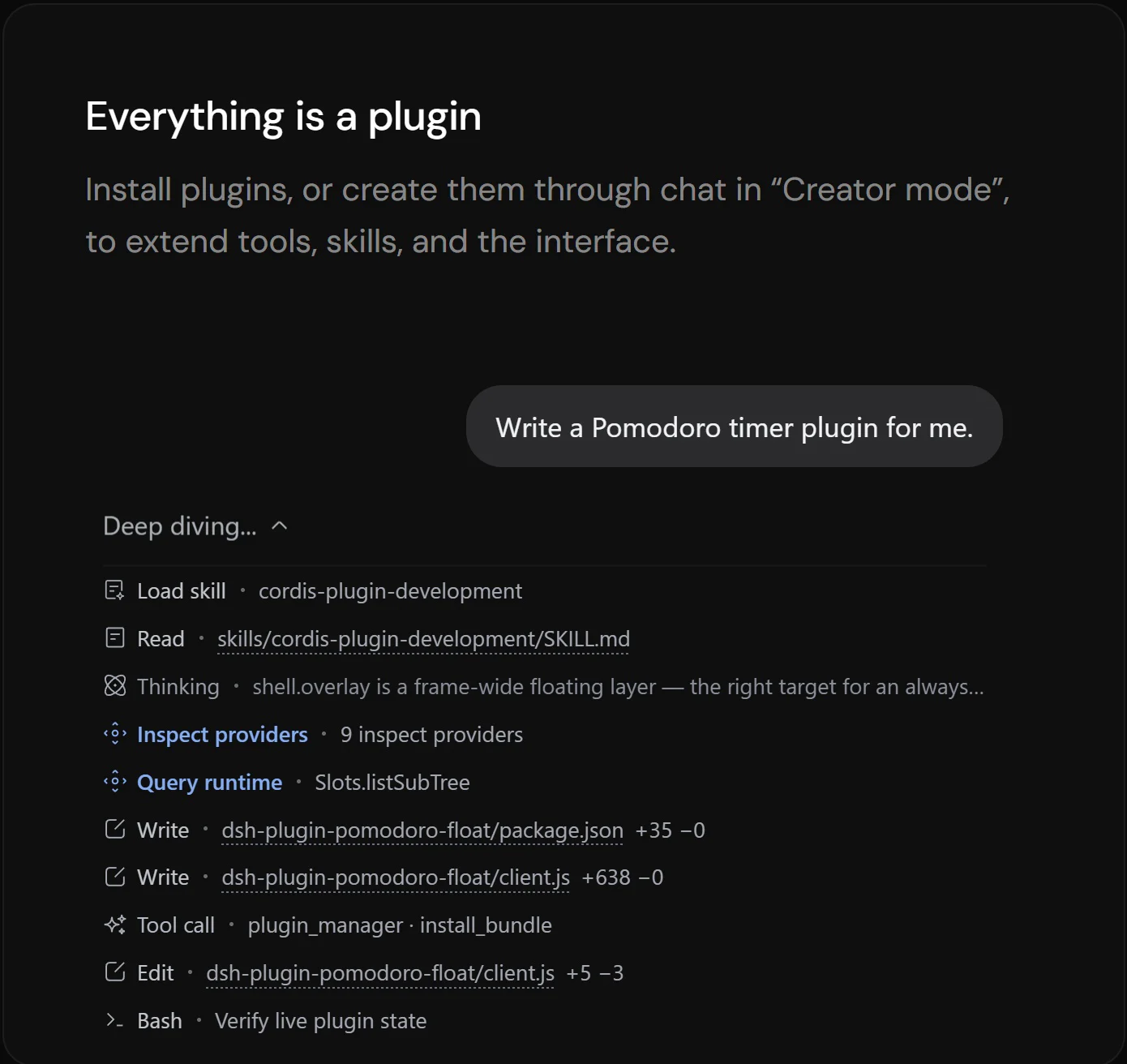
In the showcase animation on DeepSeek’s Harness page, the user tells the agent only: “Write a Pomodoro timer plugin for me.” The agent first loads its plugin-development skill (cordis-plugin-development), reads its SKILL.md file and inspects where the plugin can sit in the interface. It then writes the plugin’s package.json and a 638-line main file, client.js, installs it through the plugin manager, makes a small fix to the code and verifies the live plugin state.
According to the animation, the run takes 5 minutes 24 seconds, and the floating Pomodoro timer then shows up in the plugin list as “Pomodoro timer.” The page doesn’t say whether this is a recording of a real session or a representative flow.
The plugins in the video
The real sessions in the video are longer conversations. The session bar for the first demo, a clock-out countdown plugin, reads 3 turns and 76 steps, and the agent edited 7 files. The agent notes that the session had no browser screenshot or control access, so it couldn’t verify the pixels or the console. Next come a sticky note wall, a poster studio and a sandbox game on a voxel island, with day turning into night.
Presented as a “3D LLM visualizer,” Transformer 3D Lab opens up a single five-token Transformer block in space. The sentence “the cat sat on the” passes through tokens, embeddings, Q·K·V, attention, mixing, a feed-forward layer (FFN) and logits until it becomes odds for the next word.
Style Lab switches the entire look of Harness between five styles: 8-Bit Pixel, Neon Grid, Green Terminal, Paper Press and Zen Glass. The agent edited 8 files but wrote that it couldn’t verify the rendered appearance because the session had no browser control. The montage at the end of the video shows a video editor, a 3D gallery of landmarks such as the Colosseum and the Great Wall, token and cost statistics, a workout plugin and a paper reader.
The published prompts
DeepSeek’s prompt page gives the English and Chinese prompts for seven demos in the video: a 3D gallery of famous landmarks, a 3D Transformer visualization, a pixelated interface, a poster design workbench, a video editing workbench, a paper reader and conversation statistics. The style plugin’s prompt, for example, is two sentences long: it asks for a plugin with a left sidebar entry that changes the look of the entire app and offers five styles, one of them pixelated.
The page notes that some plugins were refined through several rounds of conversation, so a single prompt may not reproduce exactly what the video shows. The prompts for the sandbox game, the clock-out countdown, the sticky note wall and the workout plugin weren’t published.
License, pricing and safety
Harness is MIT-licensed. The desktop app is a free download for macOS (Apple silicon) and Windows (64-bit), and it can also run as a local web interface through Node.js. Model usage is separate: using it with the DeepSeek API costs per token, and the official docs don’t say what signing in with a DeepSeek account costs. Every release on GitHub is marked as a pre-release, and the README stresses that the project is in developer preview and that compatibility-breaking changes are coming.
According to the project’s safety notice, Harness is experimental developer-preview software that hasn’t undergone a security audit and must not be treated as secure or production-ready. The notice says it can execute model-generated code and commands, load third-party plugins, and access the network, processes, credentials and files made available to it.
On Nov. 1, DeepSeek also published an article describing a “Super-agent” design that runs on Harness and can watch for events and start work on its own. The company says the article discusses architectural ideas and that the plugin it describes is only a prototype, not an existing Harness feature or an official DeepSeek product. It isn’t connected to the Creator Mode showcase.
The cover image is an AI-generated illustration, not a real photograph.
Sources
17 sources
- “Your Harness. You Define It. Meet Creator Mode in DeepSeek Harness.”Official Creator Mode announcement with the 99-second 1080p video; source of every clip used in the carousel. · x.com
- “DeepSeek Harness creator mode demo prompts”English and Chinese prompts for the seven demos in the video, with the note that some plugins took several rounds of conversation. · cdn.deepseek.com
- “DeepSeek Harness | Explore the limits of intelligence”Official Harness page; Creator mode description, the Pomodoro plugin animation (5m 24s), download platforms, MIT notice.deepseek.com
- “GitHub - deepseek-ai/deepseek-harness: DeepSeek Harness: Everything is a Plugin. · GitHub”Source code, MIT license, developer-preview warning and install commands. · github.com
- “Release v0.1.6-alpha.2 · deepseek-ai/deepseek-harness · GitHub”Earliest release notes mentioning Creator mode; shows the feature predates the Nov 2 showcase. · github.com
- “deepseek-harness/SAFETY.md at master · deepseek-ai/deepseek-harness · GitHub”Safety notice: experimental, not security-audited, can run model-generated code.github.com
- “deepseek-harness/docs/user/guide/providers.md at master · deepseek-ai/deepseek-harness · GitHub”Model setup: DeepSeek API key, DeepSeek account, Anthropic/OpenAI/Kimi/GLM and custom endpoints.github.com
- “DeepSeek Harness for Desktop Is Here”v0.2 preview and macOS/Windows desktop app; describes the ‘experimental creator mode’ and usage claims. · x.com
- “Today’s DeepSeek Harness 0.2.1 release supports the new DeepSeek-V4.1-Flash-1017 model.”Harness 0.2.1 and the note that the model was optimized for Harness during training. · x.com
- “DeepSeek-V4.1-Flash-1017: Wish-Driven Programming Made Real | DeepSeek API Docs”Announcement of the model used in the video; Search & Fetch note for Harness/Claude Code/Codex, open-weight links. · api-docs.deepseek.com
- “DeepSeek-V4-Pro GA Release | DeepSeek API Docs”V4-Pro release and peak/off-peak API pricing from Aug 16, 16:00 UTC. · api-docs.deepseek.com
- “Your First API Call | DeepSeek API Docs”States deepseek-flash is served by V4.1-Flash-1017, Harness is in worldwide developer preview, and the DeepSeek API works inside Claude Code, GitHub Copilot and OpenCode.api-docs.deepseek.com
- “Exploring Super-agent Design: Towards a More Autonomous Agent System”Architecture essay on a proactive ‘Super-agent’; not a shipped feature, a prototype. The misapplied basis of ‘codes before you ask’. · x.com
- “We’re launching DeepSeek-V4-Pro today!”V4-Pro launch (same day Harness appeared); Codex optimization and the new API pricing thread. · x.com
- “DeepSeek showcases Creator Mode for building custom plugins through conversation”News report on the Nov 2 Creator Mode showcase, its demos and the seven prompts. · technode.com
- “DeepSeek Harness launches as open source rival to Claude Code, alongside V4-Pro on API with higher prices”Harness launch coverage; origin of the ‘Claude Code rival’ framing (the outlet’s, not DeepSeek’s). · venturebeat.com
About this story
- Written by
- Yiğit Kasap · JARRUS
- Story date
- On the site
- since Nov. 7, 2026
- Short link
thejarrus.com/en/deepseek-creator-mode- Report an error
- Spotted an error in this story? [email protected] · Instagram