ChinaFunding and dealsChips and hardware
China’s AI stocks have lost 47% of their value in four months
The STAR50 index is down 47% from its June 30 peak and has erased all of its 2026 gains. The CSI 300 is on its longest weekly losing streak since 2005.
Cover of the Instagram post.
Sources: Reuters, CNN, Bloomberg +7
STAR50 is 47% below its peak
The STAR50 index, made up of the 50 largest stocks on Shanghai’s tech-focused STAR Market, closed at 1,160.84 on October 30, 2026. It fell 5.48% on the day, its steepest daily drop since August 19. That puts the index 47.4% below its June 30 peak close of 2,207.86, and at its lowest close since August 21, 2025. The index ended 2025 at 1,344.20, so it is now down 13.6% for the year, erasing all of its 2026 gains. It lost 24.1% in October alone and 13.7% in the week ended October 30.
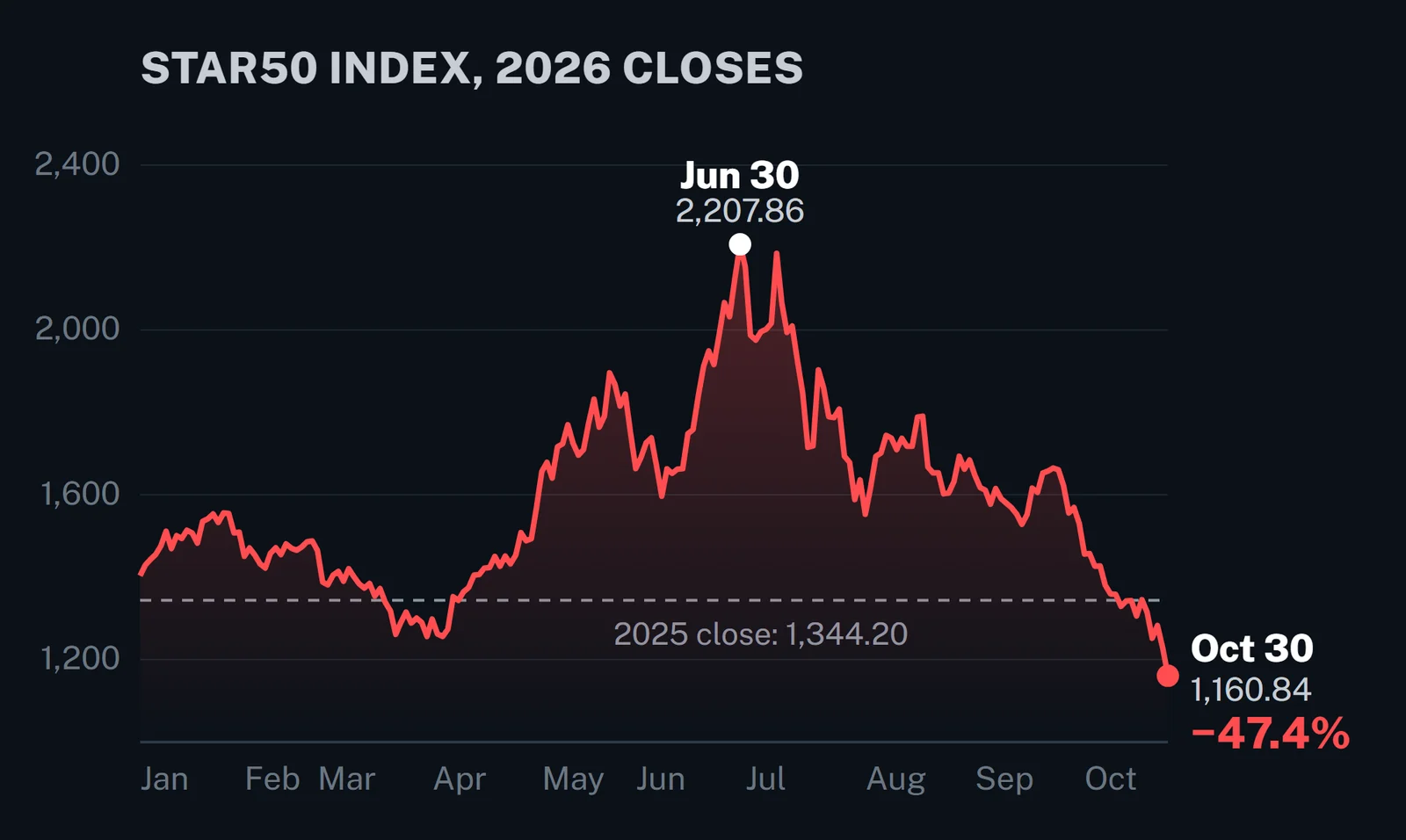
On October 26, Reuters published an analysis headlined “In China, the AI bubble has already burst.” It said the STAR50 index of AI and semiconductor leaders had fallen 40% in less than four months, wiping out about $480 billion in market value. The index’s October 26 close (1,315.50) was indeed 40.4% below the peak. Goldman Sachs data cited by Reuters show AI stocks make up 42% of China’s market value and 57% of its trading volume. The analysis doesn’t explain how the $480 billion figure was calculated, and the index has fallen about another 12% since then.
No obvious trigger
Reuters says there is no single, obvious reason for the selloff. Traders point to high prices, tax bills and the threat of the US or other countries banning Chinese equipment from data centers. According to the analysis, the index’s price-to-earnings ratio was near 250 at its peak and is now about 100, compared with about 30 for the Nasdaq 100. Reuters also reported that state-backed investors sold into rallies to keep gains in check. Wang Zhuo of Shanghai Zhuozhu Investment expects chip and AI suppliers to eventually end up in a price war.
No new US ban has taken effect. In early August, Reuters reported that the White House and the FCC were working to ban Chinese-made optical transceivers. The FCC’s equipment authorization rules finalized in September did not cover them. A bipartisan bill introduced in the Senate in late September would bar Innolight and Eoptolink transceivers from US national security systems after a five-year transition, but it has not become law. Reuters itself describes Washington as moving towards a ban, not imposing one.
Companies since their peaks
The figures below run from each company’s highest 2026 close to its October 30 close, using prices adjusted for bonus shares and splits (Eastmoney):
- Eoptolink (optical modules): down 67.9%, peak June 25.
- Zhongji Innolight (optical modules): down 60.0%, peak June 22.
- Moore Threads (AI chips): down 57.5%, peak July 9.
- MetaX (AI chips): down 54.2%, peak July 9.
- Hygon Information (processors and accelerators): down 54.0%, peak June 30.
- Cambricon (AI chips): down 44.8%, peak June 30.
- SMIC A shares (chip manufacturing): down 44.1%, peak July 9.
- CXMT (memory): down 32.4%, peak August 17.
- Unitree (humanoid robots): 23.4% below its first-day close of 845 yuan.
Unitree needs a note. Reuters and CNN wrote that the stock has halved since its August listing. That was true at the October 15 low, when it fell to 405.10 yuan, 52% below its first close. It then rebounded quickly and closed at 647.05 yuan on October 30.
The broader market: 12 weeks for the CSI 300
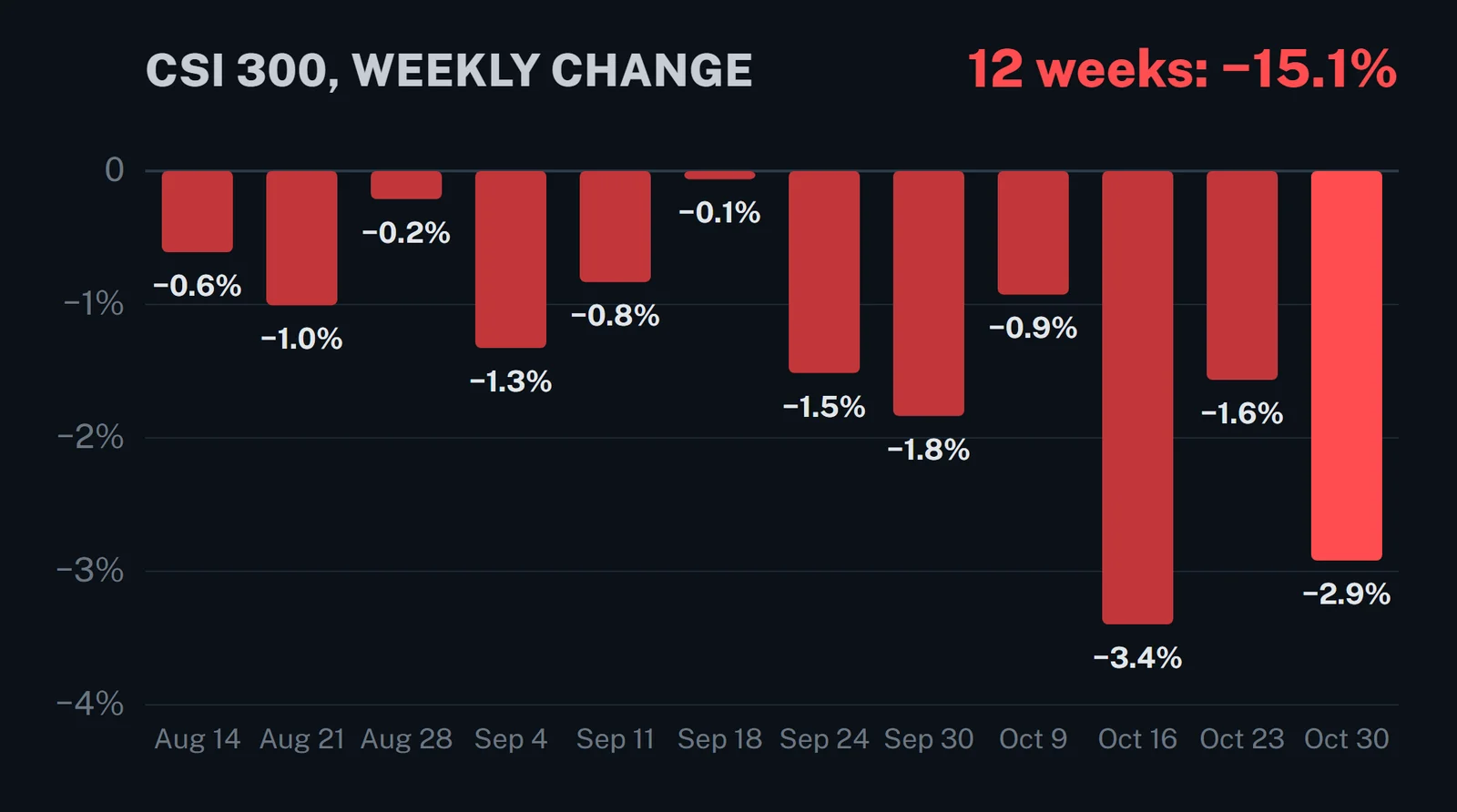
China’s benchmark CSI 300 index closed at 3,985.50 on October 30 and lost 2.9% for the week, its 12th straight weekly decline. According to Reuters, that is the longest losing streak since the index was created in 2005. The index lost 15.1% over those 12 weeks. On October 22 it fell 20.2% below its June 22 peak, entering a bear market; the October 30 close is 21.2% below the peak and the lowest since July 2025. According to Bloomberg, China’s onshore stock market had lost about $2.4 trillion in value from its May peak as of October 22.
Beijing’s response
CNN, citing Bloomberg data, reported that Beijing pumped about $19 billion into exchange-traded funds in the week ended October 23, calling it the biggest intervention since early 2025. On October 28, Richard Tang of Julius Baer said the so-called national team of state-backed funds had clearly stepped up its purchases of A-shares in recent sessions. At the Financial Street Forum on October 19, China Securities Regulatory Commission chairman Wu Qing vowed to do everything possible to maintain the safety and stability of the capital market and encouraged companies to step up share buybacks.
On the evening of October 26, after the market closed, the People’s Bank of China announced a bond market swap facility for non-bank financial institutions facing large redemptions. Governor Pan Gongsheng had described it on October 19 as “a liquidity backstop for large redemptions by non-bank financial institutions.” The facility is not a stock-buying program; the central bank presents it as a complement to its 2024 swap facility for the stock market.
Earlier, on October 9, China’s Communist Party and cabinet issued guidelines calling for avoiding bubbles, industrial hollowing-out and blind investment in “new productive forces,” including AI.
Has the bubble burst?
The “bubble has burst” framing comes from the Reuters analysis headline and two fund managers quoted in it. Beijing-based fund manager Dong Baozhen said the market had evolved into “a speculative crazy bull” and that the bubble is now bursting; Wang Zhuo said all bubbles inevitably burst. What has burst is stock valuations, not the industry itself: according to Reuters, the index still trades at about 100 times earnings.
There are other views. According to Reuters, Goldman Sachs and BNP Paribas see buying opportunities in AI stocks. On October 29, James Wang of UBS said valuations for AI hardware names are now close to their historical trough. CNN notes that demand for AI chips and hardware is supporting China’s exports and its better-than-expected third-quarter growth, and asks why that boom isn’t lifting the stock market.
Sources
15 sources
- “In China, the AI bubble has already burst”Full text of the Reuters analysis (via The Express Tribune): 40%, $480 billion, valuations, fund manager comments · tribune.com.pk
- “Chinese stocks set for 12th straight weekly loss on AI-led selloff”CSI 300’s 12-week losing streak (via Free Malaysia Today) · freemalaysiatoday.com
- “China stocks rebound on ETF buying”The streak is the longest since the index was created in 2005 (via Business Recorder) · brecorder.com
- “China stocks fall as tech shares extend slide”October 27 session (via Business Recorder) · brecorder.com
- “China stocks rebound as tech shares track broader Asian rally”October 28 session and Julius Baer’s national team comment (via Business Recorder) · brecorder.com
- “China stocks slip as tech gauges hit over one-year lows”October 29 session and UBS’s valuation comment (via Business Recorder) · brecorder.com
- “Why isn’t China’s AI and tech boom saving its stock markets?”$19 billion into ETFs, Wu Qing remarks, exports and growth · cnn.com
- “Chinese stocks enter bear market as tech slumps, policy hopes ebb”CSI 300 enters a bear market, $2.4 trillion (via The Edge Malaysia) · theedgemalaysia.com
- “China vows to curb tech bubbles, keep AI risks in check”Party and cabinet warning on bubbles (via The Standard) · thestandard.com.hk
- “China’s Central Bank Sets Up A Backstop For Bond Funds”Central bank’s bond market swap facility · finimize.com
- “Thoughts on several issues of interest to the market”Pan Gongsheng’s October 19 speech: liquidity backstop · bis.org
- “Proposed U.S. ban on Chinese optical transceivers threatens AI data center boom”US administration work on an optical transceiver ban · fierce-network.com
- “FCC Clarifies Equipment Rules, Sparing Chinese Optical Transceiver Makers”FCC rules leave transceivers out · electronicsforyou.biz
- “Bipartisan Senate Bill Seeks Ban on Chinese Optical Transceivers from U.S. National Security Systems”Senate bill targeting Innolight and Eoptolink · executivegov.com
- “SSE Science and Technology Innovation Board 50 Index (000688)”STAR50 daily closes (chart data) · csindex.com.cn
About this story
- Written by
- Yiğit Kasap · JARRUS
- Story date
- On the site
- since Oct. 30, 2026
- Short link
thejarrus.com/en/china-ai-stocks- Report an error
- Spotted an error in this story? [email protected] · Instagram